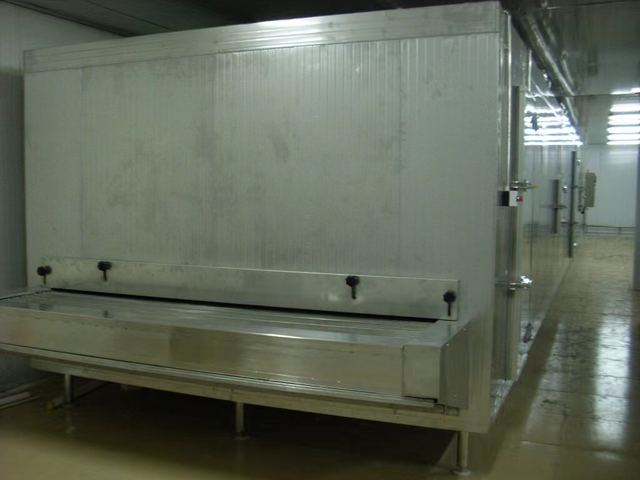
You are here:Home » Products » IQF Freezer » Tunnel Freezer » China First Cold Chain IQF Tunnel Freezer FSW400 Type with Freon Refrigerations System for All Kinds of Frozen Food
loading
Share to:
China First Cold Chain IQF Tunnel Freezer FSW400 Type with Freon Refrigerations System for All Kinds of Frozen Food
The FSW400 IQF Tunnel Freezer delivers high-efficiency flash freezing for diverse frozen foods like seafood, meat, and processed items with its advanced Freon refrigeration system. Its modular design ensures rapid freezing while maintaining product quality and texture.
- Capacity: 400kg/h processing throughput for bulk production - Construction: SUS304 stainless steel interior & polyurethane insulation for HACCP compliance - Adjustable freezing: Variable frequency control allows precise speed/time customization - Hygienic design: Smooth stainless mesh belt and water-based defrosting for easy cleaning - Applications: Ideal for IQF shrimp, fish fillets, dumplings, poultry, and ice cream products
The FST FSW400 is a straight-line IQF tunnel freezer designed for small and medium food-processing lines requiring continuous freezing, simple operation and flexible product changeover.
The reference configuration provides a nominal capacity of 400 kg/h for chicken breast. Products enter the tunnel at approximately +15°C and are cooled to a target outlet temperature of -18°C under the stated reference conditions.
Unlike a spiral freezer, the FSW400 moves products directly through a horizontal insulated tunnel. Its straightforward layout makes it suitable for factories with sufficient linear installation space and a need to process different foods on the same line.
A food-grade stainless steel mesh belt, variable-frequency speed control and adjustable freezing time allow the equipment to handle chicken portions, seafood, dumplings, pasta products and other regularly arranged frozen foods.
Technical Specifications
Item
Specification
Product name
IQF Tunnel Freezer
Model
FSW400
Brand
FST
Product code
FST4001
Reference product
Chicken breast
Nominal capacity
400 kg/h
Product inlet temperature
+15°C
Target outlet temperature
-18°C
Internal tunnel temperature
-38±3°C
Adjustable freezing time
10–50 minutes
Listed cooling capacity
70 kW
Refrigerant
R404A or R507A
Conveyor type
Food-grade stainless steel mesh belt
Conveyor speed
Variable-frequency adjustable speed
Optional belt width
Up to 2500 mm according to project confirmation
Internal material
SUS304 stainless steel
Evaporator
Anti-corrosion aluminum finned-tube assembly
Insulation
Double-sided stainless steel polyurethane panel
Panel thickness
150 mm
Panel characteristic
Self-extinguishing and flame-retardant
Defrosting method
Water defrosting
Main electrical components
Schneider
Approximate tunnel body size
11.6 × 2.5 × 2.5 m
The technical data above is based on the current FSW400 reference configuration. Final capacity, belt width, cooling load, voltage and equipment dimensions should be confirmed according to the selected food product and factory layout.
Suitable Food Forms
The FSW400 is best suited to food products that can be placed steadily on a moving mesh belt.
Chicken Breast and Poultry Portions
The published 400 kg/h reference condition is based on frozen chicken breast.
Chicken breast, chicken fillets, wings, nuggets and other poultry portions can be arranged in rows on the belt. Thicker bone-in products may require a slower conveyor speed than flat boneless portions.
Dumplings and Prepared Pasta
Dumplings, stuffed pasta and similar formed foods can be conveyed continuously when they retain their shape on the belt.
Product spacing is important because newly formed or moist products may stick together when loaded too closely.
Shrimp and Seafood Portions
Shrimp, sliced fish and other seafood products may also be processed.
Because the FSW400 uses a conventional mesh conveyor rather than a fluidized bed, delicate or highly adhesive products should be loaded carefully to reduce overlapping and belt adhesion.
Meat Portions
Sliced meat, separated meat portions and prepared meat products can be frozen when their dimensions remain suitable for the selected tunnel residence time.
Large meat blocks require a separate freezing calculation and may not achieve the same capacity as the reference chicken breast product.
Ice Cream and Packaged Foods
The existing application description also includes ice cream and other prepared frozen foods.
Packaged products must remain stable on the mesh belt, and the packaging layer should be considered when calculating the freezing time.
Straight-Line Tunnel Configuration
The FSW400 uses a horizontal product flow from the inlet to the outlet.
This design offers several practical benefits:
Products follow a visible and predictable conveying path.
The inlet and outlet can connect directly with other straight conveyors.
Operators can organize products before they enter the tunnel.
Product transfer is relatively simple.
The main mechanical structure is less complex than a spiral conveying system.
Access for inspection and sanitation can be planned along the tunnel length.
The trade-off is that a straight tunnel requires more linear factory space than a vertical spiral freezer.
The listed tunnel body length is approximately 11.6 m, so the factory layout should include additional space for product feeding, discharge, refrigeration piping and maintenance access.
Reference Chicken Breast Freezing Conditions
The standard published parameters use chicken breast as the reference frozen product.
Under the listed conditions:
Nominal capacity: 400 kg/h
Product inlet temperature: +15°C
Target outlet temperature: -18°C
Tunnel temperature: -38±3°C
Cooling capacity: 70 kW
Freezing time: 10–50 minutes
These figures should not automatically be applied to every food.
For example, 400 kg/h of small dumplings may have a different refrigeration requirement from 400 kg/h of thick meat portions. Package material, moisture, density and loading arrangement also influence performance.
A guaranteed capacity should therefore be based on the customer’s actual product specification.
Freon Refrigeration Configuration
The FSW400 product data lists R404A and R507A as the available refrigerants.
This configuration is suitable for customers seeking a tunnel freezer connected to a Freon-based refrigeration system rather than a centralized ammonia plant.
The final refrigeration system should be selected according to:
Local refrigerant requirements
Ambient temperature
Daily production hours
Product heat load
Condensing method
Available electrical supply
Maintenance capability
The published 70 kW value refers to the listed cooling-capacity requirement under the reference operating condition.
Whether the compressor unit, condenser and refrigerant accessories are included should be clearly confirmed in the commercial quotation.
Stainless Steel Mesh-Belt Conveying
The food-grade stainless steel mesh belt provides a stable surface for continuously transporting different frozen-food products.
The open mesh structure allows circulating cold air to reach the underside of the food while also allowing water and small residues to drain away during sanitation.
For stable operation:
Products should be distributed evenly.
Heavy loading in one area should be avoided.
Overlapping should be minimized.
Sticky products may require pretreatment or controlled spacing.
Belt tension and tracking should be checked routinely.
The existing page states that a conveyor width of 2500 mm can be selected according to customer requirements. The final working width should be confirmed together with the tunnel size, product-row arrangement and refrigeration load.
Thermal Insulation and Tunnel Body
The freezer enclosure uses double-sided stainless steel polyurethane panels.
The published panel specification includes:
150 mm insulation thickness
Self-extinguishing flame-retardant polyurethane
Stainless steel surfaces on both sides
This insulated construction helps maintain the -38±3°C internal environment and limit heat transfer from the surrounding workshop.
The internal structure is manufactured primarily from SUS304 stainless steel for use in food-processing environments.
Evaporator and Air Circulation
The FSW400 uses a large anti-corrosion aluminum finned-tube evaporator assembly.
The evaporator removes heat from the tunnel air, while the circulation system distributes cold air through the conveyor and product zone.
The airflow in a standard tunnel freezer is designed to surround products throughout the residence time. It is different from an impingement freezer, which directs concentrated high-pressure jets at the product surface.
For the FSW400, consistent belt loading and sufficient spacing are therefore important for maintaining airflow between products.
Water Defrosting and Sanitation
The existing product description specifies water defrosting for removing frost from the refrigeration components.
Water defrosting helps restore airflow after frost accumulates on the evaporator during production.
The installation site should provide:
Adequate water pressure
Suitable drainage
Floor slope
Space for cleaning access
Protection for electrical components
A planned defrost schedule
After defrosting, water should be fully drained before the freezer returns to low-temperature operation.
Electrical Control
The electrical cabinet uses Schneider components in the published configuration.
The standard control functions should manage:
Conveyor start and stop
Belt-speed adjustment
Fan operation
Temperature monitoring
Motor protection
Emergency stop
Fault indication
Additional PLC, touchscreen, temperature-recording or production-line synchronization functions can be discussed according to the customer’s automation requirements.
Frequently Asked Questions
Is the FSW400 only suitable for chicken breast?
No. Chicken breast is the published reference product used for the 400 kg/h specification. The freezer can also be evaluated for dumplings, pasta, shrimp, fish, meat portions and other foods.
Can different products use the same freezer?
Yes. Conveyor speed and loading arrangement can be adjusted for different foods. Products with significantly different thicknesses or inlet temperatures require separate operating settings.
Is the FSW400 a fluidized IQF freezer?
No. It is a straight stainless steel mesh-belt tunnel freezer. Small products can be frozen continuously, but the belt does not use the same fluidization action as a fluidized-bed freezer.
What is the difference between this machine and an impingement freezer?
The FSW400 uses conventional tunnel air circulation around products over an adjustable residence time. An impingement freezer uses concentrated high-pressure air jets directed toward product surfaces.
Does the 400 kg/h capacity apply to every food?
No. The published 400 kg/h capacity is based on the reference chicken breast condition. Actual capacity changes with product size, thickness, temperature and belt loading.
Can the conveyor belt width be customized?
Yes. The existing page states that a 2500 mm belt can be selected according to customer requirements. The final width must be confirmed together with the tunnel and refrigeration design.
Does the machine include the complete Freon refrigeration unit?
The page provides the refrigerant type and cooling requirement but does not clearly define the complete supply scope. Compressor, condenser and accessories should be confirmed in the quotation.
How is the freezing time changed?
The conveyor uses variable-frequency speed control. A slower belt provides a longer residence time, while a faster belt shortens the freezing cycle.