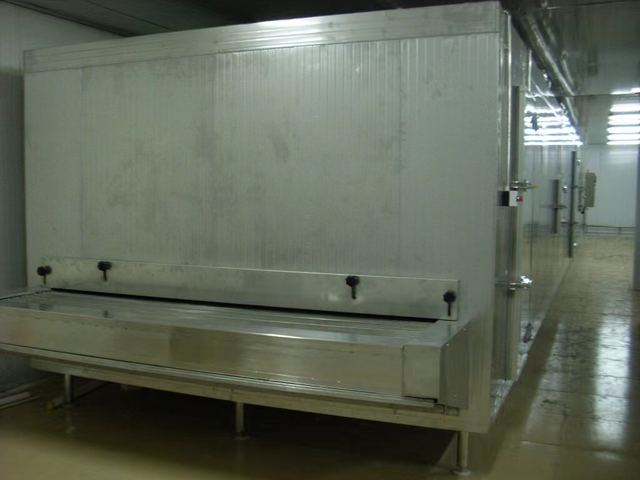
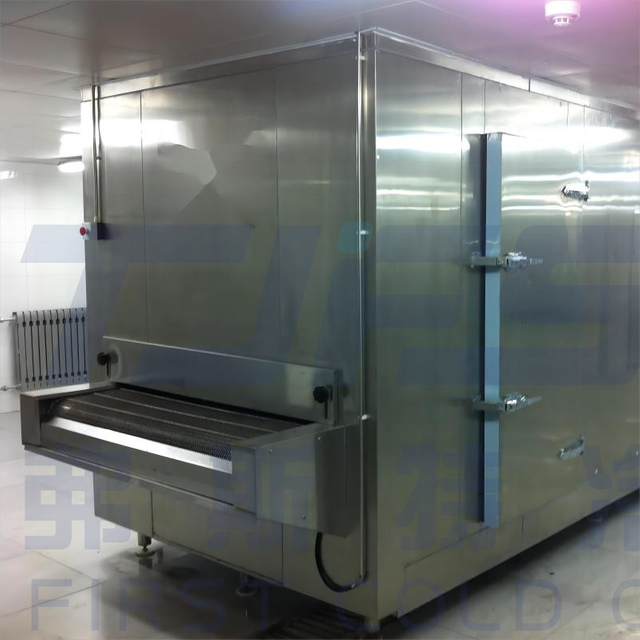
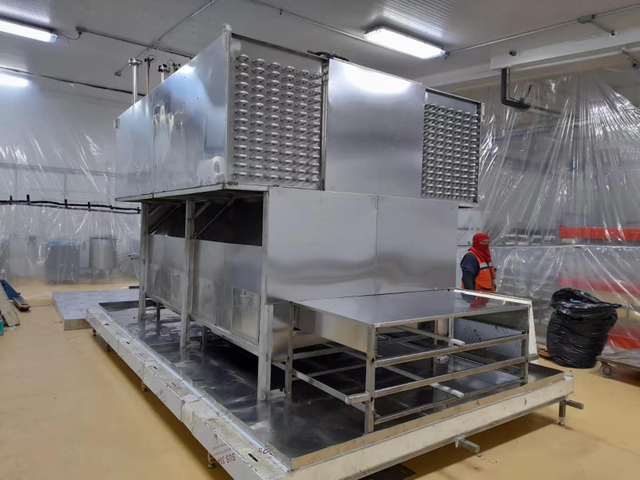
500kg/h Impingement Tunnel Freezer for Fish Processing
The FST FIW500 is a fish-oriented impingement tunnel freezer developed for loose whole fish, fillets, steaks and portioned seafood.
Unlike uniform cartons or sealed dessert packages, fish products often have curved surfaces, uneven thickness and significant size differences. The FIW500 uses a wide stainless steel mesh belt and high-velocity circulating cold air to reach the exposed upper, lower and side surfaces of the fish as it passes through the tunnel.
The standard configuration is rated at 500 kg/h for frozen fish. Conveyor speed can be adjusted to match different fish sizes, product thicknesses and target outlet temperatures. The freezer can be connected directly with grading, filleting, glazing, weighing and packing equipment in a continuous seafood processing line.
FIW500 Impingement Freezer Technical Parameters
Item | FIW500( Frozen fish ) |
Product | Frozen fish |
Capacity | 500kg/h |
In/Out Temp. | +15℃ to -18℃ |
Freezer Temp. | -35℃ |
In/Out Time | 15-75min |
Refrigerant | R404A |
Consumption | 90kw |
Freezing Container Thickness | 150mm |
Product Height | ≤100mm |
Belt Width | 1800mm |
Product Input Conveyor/Output Conveyor | 750 mm |
Water Input Pressure | ≥3 kg/cm2 |
Freezer Power | 35.2KW |
Freezer Size(L*W*H) | 9000×4000×3200mm |
Freezer Body Material | Duplex stainless steel polyurethane insulation board density or 40 kg/m3, the thickness of 150 mm, 304 stainless steel outer plate thickness more than 0.8 mm |
Main Electric Brand | Schneider(France) |
Belt and Speed | Food-grade stainless steel mesh belt; Frequency conversion stepless speed regulation |
Slide Track Material | Ultrahigh molecular polyethylene material. |
Internal Structure | All made of 304 Stainless Steel Material, Argon arc welding |
Evaporator | Effective from large aluminum finned tube set, stainless steel panel stent |
Fan and Motor | Aluminum alloy stainless steel duct fan low noise and waterproof electric power consumption |
Key Advantages
Built for Loose and Irregular Fish Products
Fish freezing cannot be selected only according to total product weight.
A 1 kg flat fillet and a 1 kg whole fish can require different freezing conditions because their thickness, exposed surface area and internal heat-transfer paths are different. Whole fish may also have curved bodies, cavities and thicker sections around the head or backbone.
The FIW500 is intended for products that are loaded directly onto the conveyor rather than being limited to one fixed carton size.
It can be evaluated for:
Loose whole marine fish
Freshwater fish
Skin-on or skinless fillets
Fish steaks
Headed and gutted fish
Trimmed fish portions
Large individual seafood pieces
Semi-packed fish products
The final capacity should be confirmed using the thickest product section, not only the average weight per piece.
Airflow Adapted to Fish Shape
The FIW500 uses high-speed cold-air circulation to improve airflow contact around irregular products.
Fish placed on a conventional solid surface may receive less cold air underneath. The FIW500 therefore uses a stainless steel mesh belt, allowing refrigerated air to circulate through the belt openings and reach the lower product surface.
The upper airflow removes heat from the exposed surface, while airflow beneath and around the fish helps reduce temperature differences between the top, bottom and side areas.
This arrangement is particularly useful for products such as:
Whole fish with curved bodies
Thick center-cut steaks
Fillets with tapered edges
Mixed-size fish portions
Fish with uneven surface contact
Products should still be loaded with sufficient spacing. The airflow system cannot compensate for heavily overlapping or tightly stacked fish.
Product Loading for Consistent Freezing
Correct loading is one of the most important operating factors in a fish tunnel freezer.
Single-Layer Arrangement
Whole fish, fillets and steaks should normally be placed in a single layer. Single-layer loading allows more product surface to remain exposed to the cold air.
Controlled Product Spacing
A small gap should be maintained between adjacent products. When fish touch or overlap, the contact area may freeze more slowly than the exposed surface.
Similar Thickness in Each Batch
Products with widely different thicknesses should not always be processed at the same belt speed. Separating thin fillets from thick whole fish makes the outlet temperature easier to control.
Stable Placement on the Belt
Light fillets and small portions should be positioned so that high-speed airflow does not fold, move or overlap them during conveying.
Surface Water Control
Fish entering directly after washing may carry free water. Excessive surface water can increase frost formation, contribute to product sticking and add heat load to the freezer.
Draining or controlled dewatering before loading may therefore improve operation.
Freezing Control Based on Product Thickness
The FIW500 uses variable-frequency stepless conveyor-speed regulation. The listed residence-time range is 15–75 minutes.
The correct belt speed should be selected according to:
Fish species
Whole fish or cut product
Maximum thickness
Weight per piece
Bone content
Inlet temperature
Required core temperature
Belt loading density
Daily production schedule
Thin fillets may require a shorter residence time, while thick whole fish, steaks or blocks may require slower conveying.
For stable production, the product core temperature should be checked during commissioning. Belt speed can then be adjusted using actual temperature results rather than appearance alone.
Fish Products Suitable for the FIW500
Whole Fish
Whole fish can be arranged head-to-tail or in parallel rows according to body width and conveyor capacity.
For whole fish, the freezing calculation should consider the thickest body section. Large differences in fish size may require grading before freezing.
Fish Fillets
Fillets are generally flatter and have a larger exposed surface area than whole fish.
They should be laid flat without folding. Delicate fillets may require careful transfer between the preparation conveyor and freezer belt to preserve shape.
Fish Steaks
Fish steaks have a relatively consistent cut shape but may remain thick around the backbone.
The production team should control steak thickness to reduce differences in outlet temperature.
Headed and Gutted Fish
Removing the head and internal organs changes the shape and thermal load of the product.
The open cavity may improve air exposure, but the final freezing time must still be confirmed using the product’s maximum thickness.
Semi-Packaged Seafood
Trays, open cartons and other semi-packaged products may be evaluated, but packaging can restrict airflow.
Package height, openings, material and loading arrangement should be reviewed before confirming capacity.
FAQs
Can whole fish and fillets use the same belt speed?
Not necessarily. Fillets are usually thinner than whole fish and may reach the required temperature faster. Belt speed should be adjusted according to the thickest section of each product.
Should fish be placed in a single layer?
Single-layer loading is recommended for more consistent airflow exposure. Overlapping products may create slower-freezing contact areas.
Can wet fish enter the freezer directly after washing?
It is possible, but excessive free water can increase frost formation and product sticking. A draining or dewatering step may improve freezer operation.
Can the FIW500 connect directly to a glazing machine?
Yes. The outlet height, line speed, transfer arrangement and required product temperature should be coordinated with the glazing equipment.
Is the freezer suitable for both marine and freshwater fish?
It can be evaluated for both. The final configuration depends more on product dimensions, thickness, loading and inlet temperature than on the water source alone.
Can packaged fish be processed?
Some trays, cartons and semi-packaged fish products can be processed, but the packaging may reduce airflow exposure. Package dimensions and openings should be reviewed during selection.
How is the 500 kg/h capacity confirmed?
The stated capacity is a reference value for frozen fish. A guaranteed output requires confirmation of fish size, weight, maximum thickness, inlet temperature, outlet temperature and belt arrangement.