You are here:Home » Blogs » Industry Hotspots » Tunnel Blast Freezing for Meat: How Thickness, Packaging, and Loading Affect Freezing Time
Tunnel Blast Freezing for Meat: How Thickness, Packaging, and Loading Affect Freezing Time
Views: 0 Author: Site Editor Publish Time: 2026-08-04 Origin: Site
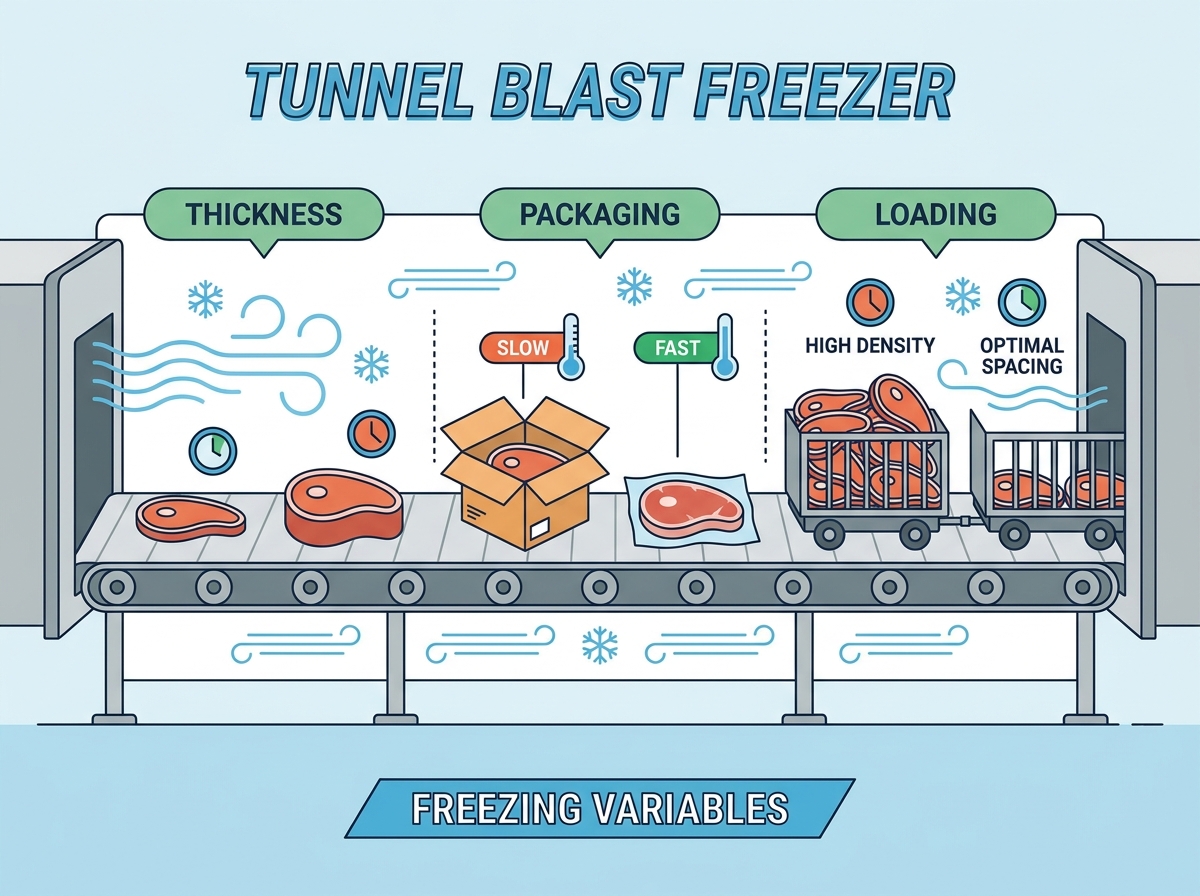
High-volume meat processing facilities face a constant tension between throughput and product quality. Inefficient thermal transfer leads to production bottlenecks, severe yield loss, and increased energy expenditures. Unpredictable freezing times are rarely a failure of the refrigeration plant alone. They are typically the result of misaligned operational variables. Specifically, variable meat thickness, highly insulated packaging, and suboptimal belt loading obstruct airflow. To maximize the return on investment of a tunnel blast freezer, facility engineers and plant managers must evaluate the exact thermodynamic relationship between the product, its packaging, and the equipment's continuous airflow design. Understanding these variables ensures consistent core temperatures and prevents costly production delays. Plant operators must move beyond theoretical capacity charts and look at the physical realities on the conveyor belt. By addressing the root causes of thermal resistance, you can stabilize production schedules and protect product integrity.
Key Takeaways
Thickness Dictates Dwell Time: Freezing time increases exponentially, not linearly, with product thickness, requiring precise belt speed calibration.
Packaging is a Thermal Barrier: Trapped air and corrugated materials act as insulators; optimizing case design and airflow alignment can reduce freezing times by up to 50%.
Loading Density Controls Airflow: Maximizing belt coverage without obstructing vertical or horizontal airflow prevents dead zones and uneven freezing.
Continuous vs. Batch Efficiency: Tunnel blast freezers offer superior consistency for uniform meat products compared to batch blast freezers, provided the input variables remain stable.
IQF vs. Bulk Blast Freezing: Choosing between Individual Quick Freezing (IQF) and bulk/crust tunnel blast freezing depends entirely on product size, target ice crystal formation, and desired moisture retention.
The Mechanics of a Tunnel Blast Freezer in Meat Processing
Problem Framing (Success Criteria)
Industrial meat freezing demands strict baseline requirements. The primary goal is achieving rapid core temperature reduction. This rapid drop halts microbial growth immediately. It also minimizes drip loss during the thawing process. Success is measured by consistent core temperatures across all product batches. Facilities must balance this speed with energy consumption. Any deviation compromises food safety and product yield. When you walk the floor of a high-capacity plant, the success of the freezing line dictates the pace of the entire operation. If the freezer backs up, the cutting floor stops.
We measure success by the speed at which the thermal center of the meat passes through the zone of maximum ice crystal formation. This zone typically lies between -1°C and -5°C. The faster the meat transitions through this temperature band, the smaller the ice crystals. Small ice crystals protect the cellular structure of the muscle tissue. Large ice crystals act like microscopic knives, puncturing cell walls and causing massive purge when the end-user thaws the product.
Continuous vs. Batch Systems
Continuous tunnel freezers operate using conveyor-driven, steady-state mechanics. They move product through controlled temperature zones seamlessly. Traditional batch blast freezers rely on palletized, static rooms. Batch systems require manual loading and unloading. Continuous systems eliminate this labor-intensive step. They are critical for high-throughput, uniform meat lines. Steady airflow in a tunnel ensures every product receives identical thermal treatment.
In a batch system, the pallets in the center of the room freeze much slower than those near the evaporators. This creates a wide variance in product quality within the same batch. A continuous system solves this by moving every single box or piece of meat past the same evaporators at the same speed. The thermodynamic exposure is identical for unit one and unit ten thousand.
IQF vs. Bulk/Crust Tunnel Blast Freezing
Individual Quick Freezing tunnels serve a specific purpose. They are designed for rapid, separate freezing of small pieces. Diced meat and poultry parts benefit greatly from IQF technology. Standard tunnel blast freezers handle different loads. They are designed for larger primal cuts and boxed meats. Bulk tunnels focus on penetrating dense, packaged items. Choosing the right system depends entirely on your product dimensions.
IQF systems often use fluidization. High-velocity air blows up through a mesh belt, lifting the small meat pieces and freezing them individually so they do not clump together. Bulk tunnels use directed horizontal or vertical airflow to strip heat away from heavy boxes or large bare cuts resting flat on the belt. You cannot run 60-pound boxes of beef trim through an IQF fluidization tunnel, and running diced chicken through a bulk tunnel will result in a solid, frozen block of meat.
Baseline Operating Parameters and Protocols
Meat freezing requires specific standard temperature ranges. Systems typically operate between -30°C and -40°C. High-velocity airflow is an absolute necessity. Fast air strips away the thermal boundary layer surrounding the product. Protocol requirements dictate reaching a safe core temperature rapidly. The target is usually -18°C within regulated time frames. Meeting these protocols ensures strict food safety and regulatory compliance.
Pre-chill the tunnel to the target operating temperature before introducing any product to the belt.
Verify airflow velocity across the belt using an anemometer to ensure no dead zones exist.
Load the product according to the specified density pattern for that specific SKU.
Monitor the core temperature of the thickest piece of meat exiting the tunnel during the first hour of production.
Adjust the variable frequency drive on the conveyor belt to speed up or slow down the dwell time based on the core temperature readings.
How Meat Thickness Dictates Freezing Time and Equipment Sizing
The Physics of Thermal Conductivity in Meat
Meat thickness shares a non-linear relationship with freezing time. Plank’s Equation principles explain this thermodynamic behavior clearly. Heat extraction slows down as the frozen outer layer thickens. This frozen crust acts as an internal insulator. Doubling the meat thickness can more than quadruple the required freezing time. Operators must account for this exponential increase during production planning.
When the surface of a beef roast freezes, that frozen layer has a different thermal conductivity than the unfrozen center. The refrigeration system must pull heat from the warm center through the frozen crust. As the crust gets thicker, the heat transfer rate drops dramatically. This is why you cannot simply extrapolate freezing times linearly. A 4-inch thick cut does not take twice as long to freeze as a 2-inch cut; it takes significantly longer.
Surface Area-to-Volume Ratios
Thick primal cuts present unique freezing dynamics. Beef rounds and whole poultry have low surface area-to-volume ratios. They require extended dwell times to freeze completely. Thin, processed items freeze much faster. Burger patties and chicken breasts have high surface area-to-volume ratios. They absorb cold air rapidly across their broad surfaces. Mixing these profiles on one line causes severe processing inefficiencies.
If you run thin burger patties and thick beef chubs on the same belt, you have to set the belt speed for the chubs. This means the burger patties will stay in the tunnel long after they are fully frozen. This wastes refrigeration capacity and exposes the patties to unnecessary dehydration. Production scheduling must group products with similar surface area-to-volume ratios to maximize the efficiency of the freezing equipment.
Ice Crystal Formation and Tissue Integrity
Freezing speed directly impacts overall meat quality. Slow freezing in thick cuts creates large extracellular ice crystals. These large crystals rupture delicate muscle fibers. This damage leads to excessive purge and moisture loss upon thawing. Texture degrades significantly when cellular integrity is compromised. The rapid heat extraction of a high-velocity tunnel blast freezer for meat preserves this cellular structure.
We see this constantly in poorly managed facilities. They overload the belt with thick cuts, the air temperature rises, and the freezing process drags on for hours. When that meat is thawed for further processing, the floor is covered in red purge. That purge is lost weight, and lost weight is lost revenue. Rapid freezing locks the moisture inside the muscle cells where it belongs.
Evaluation Dimension
Buyers must size equipment based on their thickest product. Evaluate the largest SKU in your production mix carefully. The evaporator coils must handle the maximum thermal load. The belt length must accommodate the longest required dwell time. Undersizing the unit leads to incomplete freezing. Oversizing wastes valuable floor space and energy resources.
Meat Product Type
Average Thickness
Estimated Dwell Time (-35°C Air)
Primary Limiting Factor
Burger Patties (Bare)
0.5 inches
15 - 25 minutes
Surface dehydration
Chicken Breasts (Bare)
1.0 inches
35 - 50 minutes
Belt loading density
Pork Loins (Vacuum Packed)
3.5 inches
120 - 160 minutes
Internal thermal resistance
Boxed Beef Trim (Corrugated)
6.0 inches
240 - 360+ minutes
Packaging insulation
The Impact of Packaging on Thermal Resistance
Packaging Materials as Insulators
Common meat packaging materials possess varying thermal resistance. We measure this resistance as an R-value. Bare products freeze rapidly without any thermal barriers. Poly-wrapped meats experience slight delays in heat transfer. Vacuum-sealed products perform better by eliminating internal air. Corrugated cardboard boxes act as heavy insulators. They drastically slow down the freezing process.
Cardboard is literally designed to trap air within its flutes. This makes it a great material for keeping things warm, which is the exact opposite of what you want in a freezing tunnel. When you place a 60-pound block of meat inside a corrugated box, you are forcing the refrigeration system to fight through a layer of insulation before it even reaches the product. This extends dwell times massively and requires much longer conveyor belts.
The Danger of Air Gaps and Headspace
Trapped air inside a sealed package is dangerous. It acts as a highly effective thermal insulator. Air gaps severely retard the penetration of cold air. Headspace in boxes prevents direct contact with the freezing environment. This insulation effect forces the equipment to work harder. Eliminating trapped air is crucial for efficient thermal transfer.
If a box is only filled to 80% capacity, the remaining 20% is just dead air. Cold air from the evaporators hits the outside of the box, cools the cardboard, and then has to cool the dead air inside before it can start pulling heat from the meat. Vacuum packaging eliminates this headspace entirely. The plastic film sits tight against the meat, allowing for direct thermal transfer from the cold air to the product surface.
Case Redesign and Airflow Alignment
Real-world design optimizations yield massive efficiency gains. Blast freezer air patterns must match product packaging cases. Redesigned cases feature strategic ventilation slots. These slots allow cold air to flow directly over the meat. This synergy can reduce overall freeze times by up to 50%. Proper airflow alignment maximizes the equipment's cooling capacity.
We often work with packaging engineers to punch specific holes in the sides and ends of corrugated boxes. If the tunnel blows air horizontally across the belt, the holes must align with that airflow. The cold air enters one side of the box, strips heat directly from the poly-wrapped meat inside, and exits the other side. This simple mechanical change can cut hours off the required dwell time.
Implementation Risk
Specifying a freezer based on bare-meat data is risky. Actual production lines often freeze packaged goods. Bare-meat calculations will drastically underestimate the required dwell time. This mismatch leads to soft centers and rejected batches. Always test freezing times using final, production-ready packaging. Accurate testing prevents costly equipment modifications later.
I have seen facilities purchase a multi-million dollar freezing system based on the thermal data of bare chicken breasts. Six months later, marketing decides to sell the chicken in retail-ready cardboard cartons. The plant runs the cartons through the tunnel, and the core temperatures come out at -2°C instead of -18°C. The equipment was not designed for the thermal resistance of the carton. You must engineer the system for the final packaged state.
Belt Loading and Airflow Optimization
Belt Speed Calibration
Variable frequency drives are necessary on conveyor belts. VFDs allow operators to adjust dwell times precisely. Different meat profiles require different exposure times. Dynamic control over freezing times ensures consistent quality. Operators can slow the belt for thick cuts. They can speed it up for thin, bare products.
The VFD is the steering wheel of the freezing tunnel. Without it, you are locked into a single production speed regardless of what product is coming down the line. Plant managers must map out the required VFD hertz settings for every single SKU. These settings should be posted directly on the control panel so operators do not have to guess the correct speed during changeovers.
Product Spacing and Airflow Dynamics
Meat must be arranged strategically on the belt. Poor spacing creates a phenomenon known as channeling. High-velocity air bypasses densely packed product easily. It takes the path of least resistance through empty gaps. This creates dead zones where meat freezes too slowly. Uniform spacing forces air to move over every product surface.
Air behaves like water; it will always take the easiest route. If you dump a massive pile of meat in the center of the belt and leave the edges empty, the cold air will simply rush down the empty edges. The meat in the center will not receive the necessary convective cooling. You must spread the product evenly across the entire width of the belt to force the air to push through the product load.
Loading Density vs. Throughput
Overloading the belt maximizes theoretical throughput on paper. However, it severely restricts necessary airflow in practice. Restricted airflow increases the actual freezing time significantly. It risks incomplete core freezing and food safety violations. Finding the optimal loading density is an operational trade-off. You must balance volume with thermodynamic efficiency.
There is a physical limit to how much heat the evaporators can remove per minute. If you put 10,000 pounds of warm meat on the belt when the system is only designed for 5,000 pounds, the air temperature inside the tunnel will rise. The refrigeration plant will run at 100% capacity and still fail to pull the temperature down. The meat will exit the tunnel soft, and you will have to put it in a holding freezer to finish the job, defeating the entire purpose of the continuous system.
Mitigation Strategy
Implement standard operating procedures for belt loading. Create specific patterns for primal cuts and boxed meats. Individual portions require different spacing than large boxes. Train line workers to maintain these exact loading patterns. Consistent loading prevents channeling and eliminates dead zones. SOPs guarantee predictable freezing times across all shifts.
Define the exact gap required between boxes (e.g., 2 inches on all sides) to allow vertical airflow penetration.
Install physical guides or laser lines on the infeed conveyor to help workers align the product correctly.
Assign a dedicated quality control technician to monitor the infeed belt density every 30 minutes.
Use automated spreading shakers for small IQF products to ensure an even bed depth before entering the freezing zone.
Evaluating a Tunnel Blast Freezer: Buyer’s Decision Framework
Feature-to-Outcome Mapping
Evaluating hardware components requires matching features to production outcomes. Evaporator coil design impacts continuous run times. Fan configurations determine air penetration through dense loads. Belt materials affect sanitation and airflow dynamics. You cannot just look at the total horsepower; you have to look at how that power is applied to the product.
Component
Feature Options
Operational Outcome
Evaporator Coils
Wide fin spacing vs. dense fins
Wide spacing extends run times between defrost cycles by accommodating more frost buildup.
Fan Configurations
Axial vs. Centrifugal fans
Centrifugal fans overcome high static pressure from densely packed boxed meats.
Belt Types
Modular plastic vs. Stainless mesh
Stainless mesh offers superior airflow penetration and durability for heavy loads.
Defrost Systems
Hot gas vs. Water defrost
Hot gas provides faster turnaround times and clears ice from the coils more efficiently.
Enclosure Panels
4-inch vs. 6-inch insulated panels
Thicker panels reduce thermal infiltration and lower the load on the refrigeration plant.
Protocol Validation and Monitoring
Real-time monitoring is essential for quality control. Assess the system’s provision for tracking air temperature. Monitor air velocity and belt speed continuously. Ensure the setup allows teams to validate core temperatures. Consistent monitoring proves that thresholds are reached successfully. Data logging supports strict regulatory compliance efforts.
Modern systems use PLC controls to track the temperature of the air leaving the evaporators and the air returning to them. The difference between these two numbers tells you exactly how much heat is being removed from the meat. If the return air temperature starts dropping, it means the meat is getting colder and absorbing less heat. Operators use this data to fine-tune the belt speed in real-time.
Scalability and Compliance
Evaluate a system's ability to scale with future increases. Production volumes rarely remain static over time. The equipment must comply with strict food safety standards. Hygienic design principles dictate easy cleaning and inspection. Look for features that support automated clean-in-place systems. Compliance prevents costly shutdowns and product recalls.
When designing the layout, leave physical space in the facility to add modular sections to the tunnel later. If you buy a 40-foot tunnel today, make sure you have room to expand it to 60 feet when your production doubles in three years. Ensure all internal framework is fully welded stainless steel with sloped surfaces so washdown water drains immediately. Standing water inside a freezer creates massive sanitation risks.
Implementation Risks
Installation hurdles can delay project timelines significantly. Facility footprint constraints often dictate equipment dimensions. Structural floor loading must support heavy freezing equipment. The existing refrigeration plant must have adequate capacity. Insufficient central ammonia or freon capacity will cripple the new freezer. Address these infrastructure risks before signing purchase orders.
You must calculate the exact tons of refrigeration required by the new tunnel and compare it to the available capacity in your engine room. If your compressors are already running at 90% capacity during the summer months, adding a massive continuous freezer will crash the entire system. You may need to upgrade your compressors, condensers, and piping infrastructure before the tunnel even arrives on site.
Cost-to-Value Trade-Offs in Continuous Freezing Systems
Capital Expenditure (CapEx) vs. Operational Savings (OpEx)
Tunnel freezers require a high initial capital expenditure. However, they generate massive long-term operational savings. Labor costs drop because manual pallet moving is eliminated. Steady-state operation improves overall energy efficiency. Reduced product handling minimizes physical damage to the meat. These OpEx savings justify the initial CapEx quickly.
Think about the forklift traffic required to load and unload a batch blast cell. You have drivers moving pallets in, waiting 24 hours, and moving them out. A continuous system takes the product directly from the packaging line, freezes it, and delivers it straight to the palletizer. You eliminate the intermediate handling steps, reduce forklift maintenance, and cut down on the labor hours required to manage the freezing process.
Yield Preservation as a Financial Metric
Yield preservation is a critical financial metric. Rapid freezing reduces drip loss significantly. Saving just one percent in moisture weight is highly profitable. This translates to massive savings on millions of pounds annually. Preserved moisture means you sell meat, not water. Calculate ROI based on this exact yield preservation data.
If a plant processes 50 million pounds of beef annually, a 1% reduction in drip loss equals 500,000 pounds of saved product. At $3.00 per pound, that is $1.5 million in recovered revenue every single year. The capital cost of the freezing equipment is often paid for entirely by this yield preservation within the first 24 months of operation. The financial justification is clear when you look at the cellular biology of the meat.
Conclusion
A continuous freezing system is a major operational upgrade. However, its success depends on controlling physical variables. You must manage thickness, packaging, and loading density strictly. Do not rely on guesswork when configuring your production lines.
Initiate a thermal modeling study of your specific meat products to determine exact dwell times.
Conduct a comprehensive packaging audit to eliminate trapped air and improve ventilation slots.
Consult with industrial refrigeration engineers to calculate precise refrigeration loads before procurement.
Establish strict standard operating procedures for belt loading patterns to prevent airflow channeling.
FAQ
Q: What is the ideal temperature for a tunnel blast freezer for meat?
A: Typically operates between -30°C and -40°C to balance rapid freezing speeds with energy efficiency and moisture control.
Q: How does packaging affect blast freezing time?
A: Packaging materials like corrugated cardboard and trapped air act as insulators. Poorly designed packaging can double the required freezing time compared to bare or optimized products.
Q: What is the difference between a tunnel freezer and a batch blast freezer?
A: A tunnel freezer uses a continuous conveyor belt for steady-state, high-volume freezing, while a batch blast freezer requires loading static pallets into a sealed room for a set cycle.
Q: How does IQF tunnel freezing differ from bulk tunnel blast freezing for meat?
A: IQF tunnel freezing rapidly freezes individual pieces separately using high-velocity airflow to prevent clumping. Bulk tunnel blast freezing processes larger, grouped, or packaged meat products on a continuous conveyor belt.
Q: How do you calculate freezing time for meat products?
A: Freezing time is calculated using variables including initial product temperature, target core temperature, product thickness, thermal conductivity of the meat, and the velocity/temperature of the freezer's airflow.
Q: Can a tunnel blast freezer handle multiple meat thicknesses simultaneously?
A: It is highly discouraged. The belt speed must be set for the thickest item to ensure food safety, which means thinner items will be over-processed, wasting energy and potentially degrading quality.
Q: What causes freezer burn in a tunnel blast freezer?
A: Freezer burn is caused by moisture sublimation. In a tunnel freezer, it occurs if unpackaged meat is exposed to high-velocity, low-humidity air for longer than necessary due to slow belt speeds or poor airflow distribution.