You are here:Home » Blogs » Industry Hotspots » How Does a Tunnel Air Blast Freezer Work? Airflow, Trolley Loading, and Freezing Cycles Explained
How Does a Tunnel Air Blast Freezer Work? Airflow, Trolley Loading, and Freezing Cycles Explained
Views: 0 Author: Site Editor Publish Time: 2026-07-21 Origin: Site
Industrial food processing faces a major operational bottleneck when freezing phases fail to keep up with production lines. Inefficient freezing leads to product degradation, extends cycle times, and inflates energy demands. Facility managers constantly balance production throughput against strict food safety standards. Slow freezing creates massive risks on the floor. Large ice crystals form during extended cooling, which damages cellular structures and causes moisture loss that reduces final product weight. A tunnel air blast freezer solves these specific issues by providing rapid, uniform temperature reduction. We will break down the mechanical architecture, loading protocols, and evaluation criteria for facility upgrades. Understanding these systems ensures your plant maintains high yields without sacrificing quality.
High-Velocity Heat Transfer: Tunnel air blast freezers utilize forced cold air circulation to rapidly remove heat, significantly reducing cycle times compared to static freezing methods.
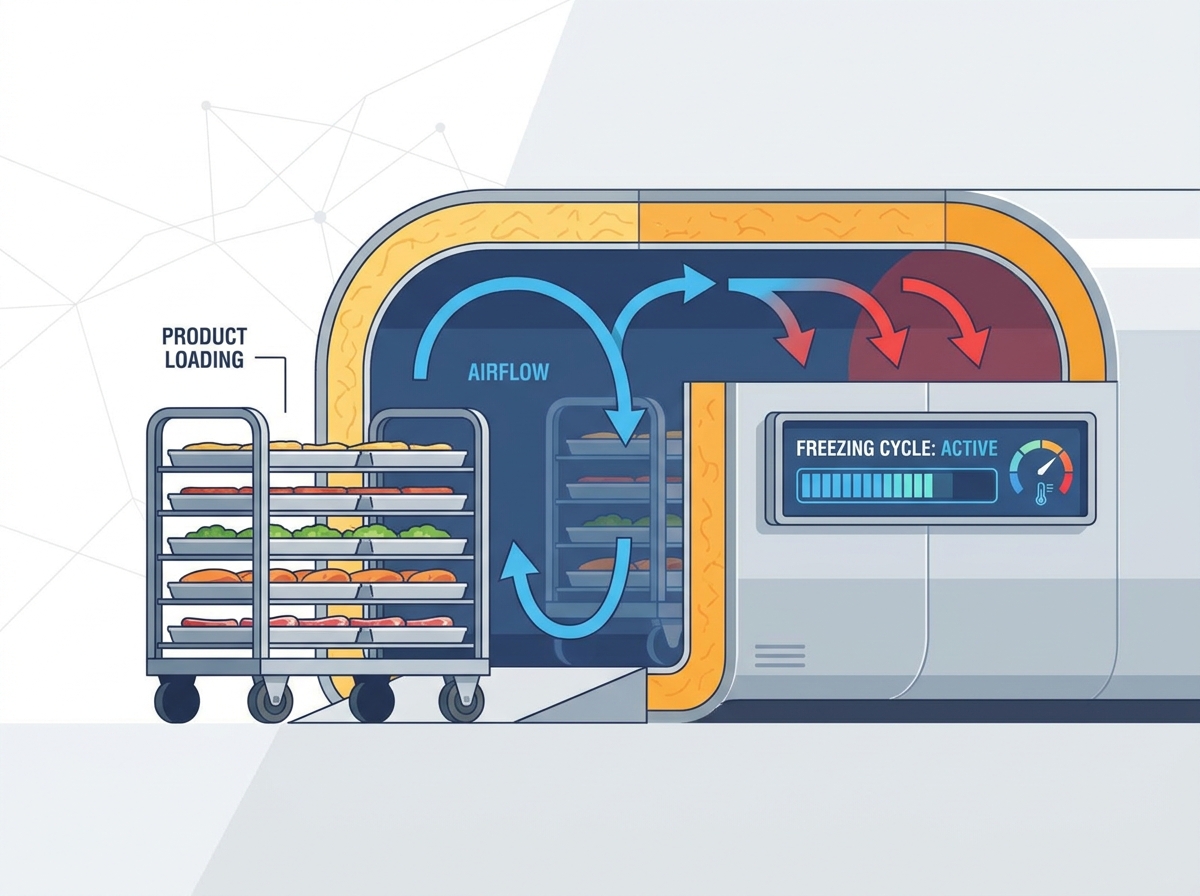
Airflow Optimization is Critical: Proper trolley loading, rack spacing, and the strategic use of freezer spacers and baffling are required to prevent airflow bypass and ensure uniform freezing across all product tiers.
Cycle Customization: Freezing cycles must be dynamically calibrated to product density, packaging, and whether the goal is bulk freezing or Individual Quick Freezing (IQF).
The Core Mechanics of a Tunnel Air Blast Freezer
Industrial-grade compressors drive the refrigeration system architecture. You will typically see two-stage ammonia or CO2 systems in large plants. Expansion valves regulate refrigerant flow precisely into the evaporators. High-capacity evaporator coils absorb heat from the circulating air. These components work together to maintain extreme sub-zero environments, often pushing temperatures down to -40°C.
Mechanical positioning dictates system efficiency. Evaporator coils sit strategically relative to high-velocity fans. Draw-through configurations pull air across the coils, which provides an even velocity profile. Blow-through setups push air through the coils, utilizing the fan motor heat to slightly defrost the coil face. Each design optimizes heat transfer differently based on tunnel dimensions and product load.
High-velocity fans generate intense static pressure. They push sub-zero air continuously through the insulated tunnel. This forced cold air circulation strips heat from the product surface. Rapid air movement prevents insulating thermal boundaries from forming around the food. We measure this static pressure in Pascals, and maintaining a high pressure drop across the load is mandatory for deep freezing.
The tunnel enclosure requires robust structural integrity. Thermal bridging prevention stops heat infiltration through the floor and wall joints. Seamless vapor barriers block moisture ingress, which otherwise destroys insulation over time. High-R-value polyurethane or polystyrene paneling provides superior insulation. We use panels at least 150mm to 200mm thick for these applications. These elements maintain the internal climate while reducing compressor load.
Compressor Racks: Provide the necessary displacement to handle massive vapor volumes at low suction pressures.
Evaporator Coils: Feature wide fin spacing to delay frost bridging during heavy moisture loads.
Axial Fans: Deliver high volumetric flow rates against significant static pressure resistance.
Insulated Enclosure: Utilizes cam-lock or continuous line panels to eliminate thermal leaks.
Airflow Dynamics and Temperature Control
Advanced multi-tunnel blast cell designs manage air velocity precisely. Variable frequency drives control fan speeds dynamically based on the cycle stage. Actuated louvers direct air distribution across the product load. This targeted approach ensures uniform cooling across all zones, preventing the center of the pallet from lagging behind the edges.
The physics of heat transfer govern the freezing process. Air velocity directly impacts cooling speed. A high temperature differential accelerates heat removal from the product surface. Increased convective heat transfer coefficients result in shorter freezing cycles. We aim for air velocities between 3 to 5 meters per second directly over the product. Anything higher wastes fan energy; anything lower extends the freeze time.
Plastic freezer spacers play a mandatory role in bulk operations. Operators insert them between stacked product layers on the pallet. They facilitate horizontal airflow through dense pallet loads. This eliminates insulating air pockets that cause uneven freezing. Without spacers, a standard pallet of boxed meat might take 72 hours to freeze. With proper 50mm spacers, that time drops to 36 hours or less.
Preventing airflow bypass maximizes system efficiency. Structural methods force air through the product rather than around it. Plenum chambers distribute pressure evenly across the tunnel width. False ceilings and adjustable baffling block escape routes over the top of the pallets. Air takes the path of least resistance. If you leave a gap between the pallet and the wall, the cold air bypasses the food entirely. We install heavy-duty curtains or physical bumpers to seal these gaps.
Trolley Loading and Product Handling Strategies
Batch processing involves loading stationary racks or carts into the chamber. Operators fill the room, shut the doors, run the cycle, and empty it. Continuous processing integrates automated conveyor belts. Products move through the tunnel without stopping, entering warm and exiting frozen. Each workflow suits different production volumes. Batch systems work well for variable product sizes. Continuous systems dominate high-throughput, uniform product lines.
Rack spacing requires careful mathematical consideration. Optimizing the surface-area-to-volume ratio accelerates freezing. Improper spacing creates warm spots deep within the load. Extended freezing cycles degrade product quality and waste energy. You must calculate the exact gap needed based on the box dimensions and the fan static pressure.
Facility-level logistics dictate material handling integration. Forklift access must be smooth and unobstructed. Automated Guided Vehicle compatibility streamlines modern operations, reducing forklift damage to insulated doors. Reinforced, insulated floor designs handle heavy trolley loads without structural failure. We install heavy-duty floor overlays, often using specialized concrete or reinforced resin, to withstand the constant point-loading of steel trolley wheels.
Handling Method
Ideal Application
Airflow Requirement
Loading Equipment
Batch Trolley
Mixed product sizes, variable schedules
High static pressure, deep penetration
Manual pallet jacks, forklifts
Continuous Conveyor
Uniform products, high volume
High velocity, surface cooling
Automated belts, vibratory feeders
Automated Rack
Heavy bulk pallets, strict FIFO
Targeted louver distribution
Automated Guided Vehicles (AGVs)
Analyzing the Freezing Cycle
The thermodynamics of blast freezing involve three distinct stages. First, the system removes sensible heat to reach the freezing point. The product temperature drops rapidly during this phase. Next, it removes the latent heat of fusion during phase change. The temperature remains relatively flat while the water turns to ice. Finally, subcooling drops the product to its final storage temperature, usually around -18°C.
Individual Quick Freezing differs vastly from bulk freezing. IQF processes unpackaged, individual items rapidly. Think of peas or shrimp moving on a belt. Bulk freezing handles dense, palletized meat blocks or packaged liquids. Bulk loads require longer cycle times and higher static pressure to penetrate the mass. IQF relies on fluidization, where high-velocity air lifts the product off the belt to freeze it instantly.
Frost buildup on evaporator coils is inevitable. As warm, moist product enters the tunnel, water vapor condenses and freezes on the cold fins. Effective moisture management requires robust defrost cycles. Hot gas, water, or electrical defrost mechanisms clear ice accumulation. Hot gas is the most efficient for large industrial plants. Efficient defrosting maintains system performance without interrupting production schedules. We often design systems with sequential defrosting, allowing one coil to melt while the others keep the room cold.
Sensible Cooling: Rapid temperature drop from ambient to 0°C.
Phase Change: Extended period where water converts to ice crystals.
Subcooling: Final temperature reduction to meet storage specifications.
Defrost Recovery: The time required to clear coils and return the room to operating temperature.
Evaluating Systems for Your Facility
Matching thermal capacity to production speed is vital. Measure capacity in kilowatts or tons of refrigeration. Align this with specific product heat loads. Underpowered systems cause production bottlenecks and compromise food safety. You must calculate the exact heat load, factoring in product entering temperature, specific heat capacity, and required freezing time.
Energy efficiency impacts long-term operating parameters. Fan motor efficiency reduces electrical draw. Compressor staging optimizes power usage during partial loads. Smart control systems manage peak-load demands effectively. We install PLC-based controllers that monitor return air temperatures and adjust fan speeds accordingly. This prevents the system from running at 100% capacity when the product is already frozen.
Facility integration requires balancing footprint constraints. Modular, expandable tunnel designs offer flexibility. Custom built-in-place systems maximize available space. Consider existing floor space and ceiling height limitations during the planning phase. You also need to account for the massive structural weight of the evaporators and the required maintenance clearances around the fans.
Sanitary design ensures regulatory compliance. Fully welded stainless steel interiors prevent bacterial growth. Sloped floors facilitate rapid drainage during washdown cycles. Clean-in-Place capabilities meet strict FDA and USDA standards. We eliminate flat surfaces where water can pool and specify IP69K-rated motors that withstand high-pressure, high-temperature washdowns.
Implementation Risks and Mitigation Strategies
Under-sizing the refrigeration plant is a severe risk. Underestimating the thermal load extends cycle times. It causes irreversible product loss and backs up the entire production line. Mandate comprehensive thermal load calculations and product testing prior to procurement. Do not rely on generic rules of thumb. Test your specific product in a pilot facility to determine exact freezing curves.
Poor airflow management creates inconsistent product quality. Blind spots in the tunnel leave products unfrozen. Require vendors to provide Computational Fluid Dynamics modeling. This proves airflow efficacy before you finalize the installation. CFD models highlight low-velocity zones and allow engineers to adjust baffle placements virtually.
Unplanned maintenance downtime cripples production. Mechanical failures happen frequently in extreme cold. Specify systems with redundancy in fan arrays. Ensure easily accessible evaporator coils. Install predictive maintenance sensors to catch issues early. Vibration sensors on fan bearings alert maintenance teams to wear before a catastrophic failure destroys the fan blade and halts the freezing line.
Conduct pilot testing to verify thermal load assumptions.
Review CFD models to confirm uniform air distribution.
Specify redundant fan motors to prevent total system failure.
Install vibration and temperature sensors for predictive maintenance.
Conclusion
Audit your current product mix to determine exact thermal load requirements and identify freezing bottlenecks.
Request Computational Fluid Dynamics models from vendors to verify airflow distribution before finalizing any tunnel design.
Assess your facility's structural capacity, specifically floor loading and ceiling height, to accommodate heavy insulated panels and evaporators.
Contact us to schedule a detailed site assessment and engineering consultation for your next facility upgrade.
FAQ
Q: What is the difference between a tunnel air blast freezer and a spiral freezer?
A: A tunnel freezer moves products linearly through a long chamber, ideal for bulk pallets or straight-line conveyors. A spiral freezer utilizes a stacked, helical conveyor belt to maximize vertical space, suited for continuous processing of individual items in compact footprints.
Q: Why are plastic freezer spacers necessary in a tunnel air blast freezer?
A: Plastic freezer spacers create horizontal gaps between stacked product layers. They allow high-velocity cold air to flow directly across the product surfaces, preventing the center of a dense pallet from remaining warm and extending the freezing cycle.
Q: How long does a typical freezing cycle take in a tunnel blast freezer?
A: Cycle times vary drastically based on product density and packaging. Unpackaged items may freeze in minutes. Dense, boxed bulk products like meat blocks can take 12 to 48 hours to freeze completely depending on the static pressure and air velocity.
Q: What is the ideal air velocity for an industrial blast freezer?
A: Ideal air velocity typically ranges between 3 to 5 meters per second over the product surface. Higher velocities increase heat transfer but yield diminishing returns regarding fan energy consumption and motor heat generation.
Q: How does trolley loading and rack spacing affect freezing times?
A: Tight rack spacing restricts airflow, creating dead zones. Proper spacing maximizes the surface-area-to-volume ratio exposed to cold air, accelerating heat removal and shortening the overall freezing cycle significantly.
Q: How is frost buildup managed during continuous blast freezing operations?
A: Systems utilize sequential defrost cycles using hot gas, water, or electric heaters. Multi-coil setups allow one evaporator to defrost while others continue cooling, maintaining uninterrupted production and stable room temperatures.