You are here:Home » Blogs » Industry Hotspots » Tunnel Blast Freezing for Bread: How Loading, Airflow, and Freezing Rate Affect Product Quality
Tunnel Blast Freezing for Bread: How Loading, Airflow, and Freezing Rate Affect Product Quality
Views: 0 Author: Site Editor Publish Time: 2026-07-31 Origin: Site
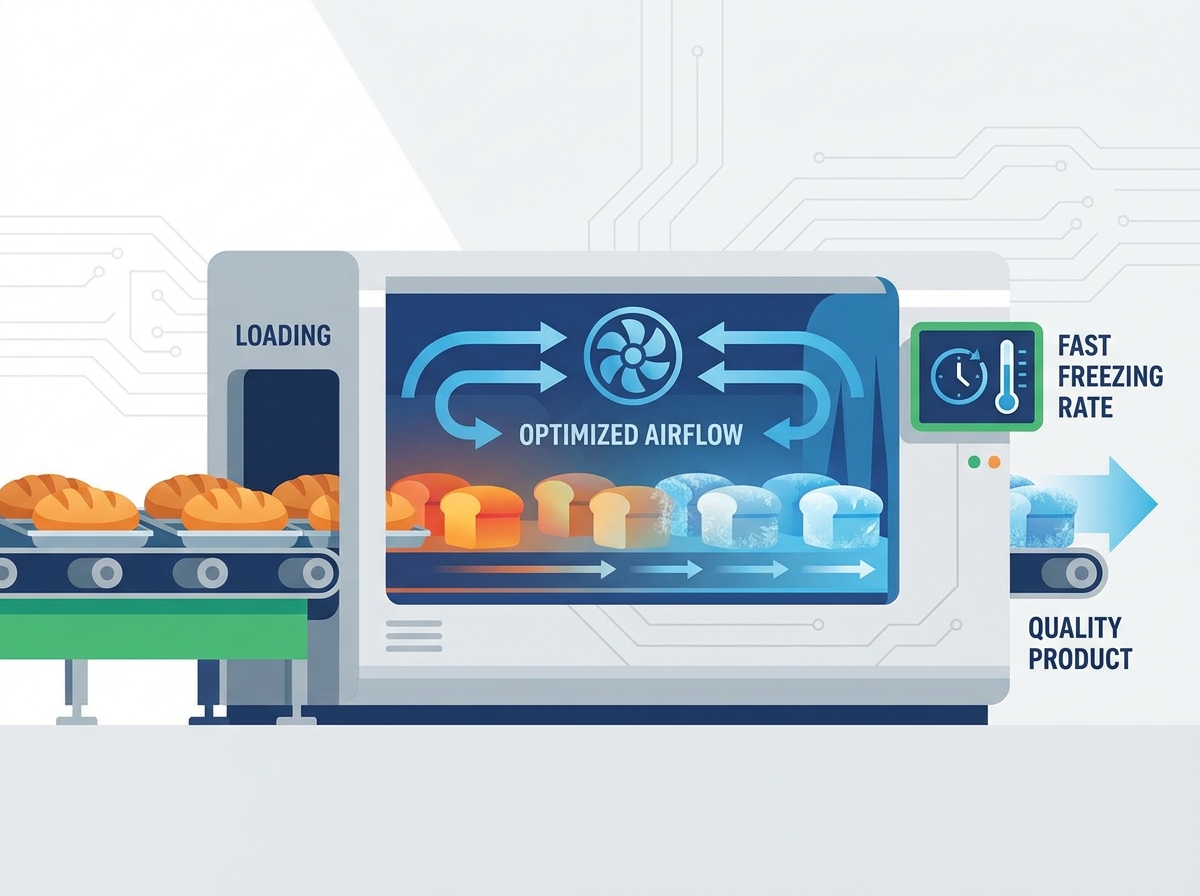
Scaling industrial bakery operations introduces a thermodynamic bottleneck. You must preserve the exact crumb structure, crust integrity, and moisture content of bread during rapid temperature reduction. Standard commercial freezing methods often result in slow temperature drops. This leads to large ice crystal formation, accelerated starch retrogradation, and moisture loss. Conversely, poorly optimized blast freezing spikes energy costs, causes uneven batch freezing, and risks surface dehydration.
Selecting the right equipment requires moving beyond basic temperature specs. This guide breaks down the technical evaluation criteria necessary to protect product quality and ensure operational efficiency. We will examine airflow dynamics, load configurations, and freezing rates. You need these details to optimize your production line when integrating a tunnel blast freezer.
Freezing Rate Dictates Quality: Rapid transition through the maximum ice crystal formation zone (-1°C to -5°C) is mandatory to prevent cellular damage and moisture migration in bread products.
Airflow Precision Over Raw Power: Unidirectional, high-velocity airflow prevents thermal gradients and turbulence, ensuring consistent heat transfer across the entire product load.
Loading Density Impacts Efficiency: Improper product spacing restricts air passage, creating micro-climates that delay freezing times and drastically increase energy consumption.
Optimization Drives Value: Balancing the initial capital expenditure of a tunnel blast freezer for bread against long-term energy efficiency, yield retention, and minimized defrost downtime is the core of the purchasing decision.
The Physics of Freezing Bread: Success Criteria for Quality Retention
Moisture Migration and Ice Crystal Formation
Water content varies significantly between par-baked and fully baked bread. During the freezing process, the critical temperature zone lies between -1°C and -5°C. If bread passes through this zone too slowly, large ice crystals form. Water expands by approximately 9% when converting to ice. This expansion physically ruptures gluten networks. You lose gas retention, and the crumb crumbles upon thawing. The primary success metric is achieving micro-crystallization. This maintains crumb elasticity and prevents cell wall rupture.
To understand the impact of freezing rates on cellular structure, consider the following data points observed in standard bakery operations:
The speed of freezing directly impacts the retrogradation of amylopectin. This is the primary cause of bread staling. A precise freezing system mitigates the staling process compared to static blast rooms. It rapidly bypasses critical staling temperatures. Faster freezing locks the starch structure in place. You preserve the fresh-baked texture upon thawing. Operators must monitor core temperatures continuously to ensure the product clears the staling danger zone rapidly.
Protecting Crust Integrity and Preventing Dehydration
Surface dehydration is a significant risk. Incorrect air velocity or excessive exposure times cause freezer burn. Rapid crust freezing is required to lock in internal moisture and preserve crispness. Properly managed airflow ensures the crust freezes quickly. This acts as a barrier against further moisture loss from the crumb. You must balance air speed with exposure time to prevent stripping moisture from the outer layers before the core freezes.
Evaluating Tunnel Blast Freezer Airflow Dynamics
Unidirectional vs. Turbulent Airflow
Unidirectional airflow prevents localized turbulence within the freezing chamber. Turbulent air causes uneven freezing. This leads to batch inconsistencies where outer products freeze faster than inner products. Consistent, unidirectional flow ensures every loaf receives the same convective heat transfer. You avoid dead zones where warm air lingers and delays the freezing process.
Mitigating Thermal Gradients Across the Belt
Engineering must maintain uniform heat transfer across the entire width and length of the tunnel. High-speed cold air circulation minimizes temperature differentials between the top and bottom of the bread. This prevents situations where the top crust freezes solid while the core remains soft. A soft core is vulnerable to staling and structural collapse during storage.
Avoiding Air Bypass
Air bypass occurs when oversized clearances between the belt, product, and tunnel walls allow cold air to bypass the bread entirely. The air takes the path of least resistance. Optimizing air passage sizing forces high-velocity air directly over and around the product surfaces. This maximizes convective heat transfer and reduces overall freezing time. Baffling systems are essential to direct air exactly where it needs to go.
Fan Placement, Baffling, and Velocity Control
Internal aerodynamics rely on variable frequency drives (VFDs) on fans, strategic baffling, and plenum design. During procurement, assess an OEM’s airflow modeling. Computational Fluid Dynamics (CFD) verifies that the design eliminates dead zones. It ensures uniform velocity across the product belt.
Request CFD models specific to your bread type and pan configuration.
Verify VFD integration for all main circulation fans to allow velocity adjustments.
Inspect the physical baffling design to ensure it forces air through the product zone, not around it.
Test air velocity at multiple points across the belt width during commissioning.
Loading Parameters and Belt Configuration Realities
Product Spacing and Air Passage Adequacy
The relationship between loading density and freezing efficiency is direct. Overloading blocks air channels. This forces the compressor to work harder, delays the core freezing time, and increases energy draw. Adequate product spacing allows air to circulate freely. You ensure rapid and uniform freezing. Operators often try to maximize throughput by packing the belt, but this usually backfires by extending the required dwell time.
Belt Types and Thermal Conductivity
Mesh belts and solid belts perform differently in bakery applications. Belt material impacts bottom-up freezing and air penetration for products like baguettes, rolls, or loaf pans. Mesh belts generally allow better airflow around the bottom of the product. This accelerates the freezing process. Solid belts might be necessary for raw doughs that could sag into a mesh, but they require aggressive top-down airflow to compensate.
Thermal Inertia of Trays, Pans, and Carrier Media
Metal baking pans or plastic trays introduce high thermal mass. This slows down heat transfer to the bottom of the bread. The freezing configuration must adapt to offset the thermal footprint of metal and plastic carrier media. You often require adjusted airflow or longer dwell times. Heavy cast iron or thick steel pans absorb massive amounts of refrigeration capacity before the bread even begins to freeze.
Managing High Water Content and Heat Loads
Dense bread doughs possess different specific heat properties compared to airy baked loaves. The initial product temperature and moisture content dictate the required refrigeration capacity and belt speed. Higher moisture content requires more energy to freeze. This impacts overall throughput. You must calculate the exact thermal load based on the heaviest, wettest product you plan to run.
Solution Categories: Tunnel Blast Freezers vs. Alternative Systems
When to Choose a Tunnel Blast Freezer for Bread
These systems are ideal for continuous inline production, uniform product shapes, and high-throughput requirements. They integrate seamlessly into automated bakery lines. You get consistent freezing without manual handling. If your facility processes thousands of loaves per hour, a continuous linear system provides the most reliable thermal control.
Tunnel vs. Spiral Freezers
Spiral freezers offer a vertical, space-saving footprint. Tunnel freezers utilize a horizontal layout. Linear systems often provide gentler handling for delicate, unbaked, or par-baked doughs. You avoid the mechanical tension and potential product shifting inherent in spiral systems. Spirals can cause dough to deform as the belt navigates the curves under high tension.
Feature
Tunnel System
Spiral System
Footprint
Long, linear, requires significant floor space
Vertical, compact, utilizes overhead space
Product Handling
Gentle, no lateral movement or belt tension shifting
Can cause shifting or deformation on curves
Airflow Dynamics
Highly controllable horizontal or vertical impingement
Complex airflow management required to penetrate tiers
Maintenance Access
Generally easier access to coils and belt sections
Can be difficult to access inner drum and center tiers
Tunnel vs. IQF Systems
Individually Quick Frozen (IQF) systems typically utilize fluidization for smaller, particulate items like berries or diced meat. This prevents clumping. Standard IQF fluidization is inappropriate for larger bread products. The high-velocity updraft required to fluidize a loaf of bread would damage the product and require absurd energy levels. Therefore, standard linear freezing remains the superior choice for bakery applications.
Overall Value Influencing Factors: Energy and Efficiency
Refrigeration Load and Compressor Efficiency
The high heat properties of bread drive up energy use. Matching compressor sizing to the specific throughput of the bakery is critical. Selecting the right refrigerant impacts long-term efficiency and operational costs. Ammonia systems offer excellent thermodynamic efficiency for large industrial plants. CO2 systems are gaining traction due to environmental regulations and excellent low-temperature performance.
Defrost Cycles and Process Delays
Frost buildup on evaporator coils due to bread moisture outgassing increases operational costs. Ice acts as an insulator, reducing the coil's ability to absorb heat. Features like sequential defrosting or air-defrost systems minimize production downtime. You ensure the freezer operates at peak efficiency for longer periods. Hot gas defrost systems are highly effective but require careful piping design.
Capital Expenditure vs. Yield Retention
Calculating return on investment requires balancing initial costs against reduced product waste, lower moisture loss, and energy savings. Higher sellable weight due to retained moisture directly improves profitability. This offsets the initial investment in high-quality freezing equipment. Every gram of water lost to the freezer coils is a gram of product you cannot sell.
Implementation Risks and Mitigation
Overcoming Condensation, Clumping, and Physical Deformation
Raw dough pieces risk touching, fusing, and deforming if loading protocols fail. Improper loading density causes adjacent dough pieces or par-baked rolls to clump. This requires separation that damages crust aesthetics. Mitigation strategies include crust-freezing zones at the tunnel entrance and mechanical separation conveyor transfers. You must ensure products are spaced correctly before they enter the freezing zone.
Maintenance, Sanitation, and Compliance
Clean-in-place (CIP) systems and hygienic design principles are essential. You need sloped floors and accessible coils. Compliance with strict bakery sanitation standards prevents mold or bacterial harborage in the freezer enclosure. Flour dust and moisture create an ideal environment for microbial growth if the system is not cleaned regularly. Fully welded stainless steel enclosures prevent moisture ingress into the insulation panels.
Conclusion
A continuous freezing system is a highly engineered thermodynamic environment where airflow and loading dictate product viability. You cannot treat it as a simple cold box. Success requires precise control over heat transfer rates and air velocity.
Demand empirical data from OEMs, specifically requesting CFD models for your specific bread type and loading density.
Conduct a facility audit to determine available footprint and structural support requirements.
Calculate exact thermal loads based on peak production hours, accounting for pan weights and dough moisture.
Schedule a pilot test with shortlisted manufacturers using your actual product formulations.
FAQ
Q: What is the ideal freezing temperature for bread in a blast freezer?
A: The standard operating range is typically -20°C to -40°C. The primary goal is to rapidly reduce the core temperature of the bread to -18°C to ensure long-term stability and prevent staling.
Q: How does a tunnel blast freezer prevent moisture loss in bakery products?
A: Rapid freezing locks water molecules into micro-crystals before they can migrate to the surface and evaporate. This preserves the internal moisture and fresh texture of the bread.
Q: What is air bypass, and how does it affect freezing efficiency in a tunnel blast freezer for bread?
A: Air bypass occurs when cold air takes the path of least resistance around the product load instead of flowing over it. This results in slow, uneven freezing times and wasted energy.
Q: What is the difference between a spiral freezer and a tunnel blast freezer for bread?
A: Spiral freezers feature a vertical, space-saving design. Tunnel freezers use a linear, horizontal continuous flow. Tunnel freezers generally offer gentler handling for delicate doughs.
Q: How does loading density affect blast freezing times?
A: Tightly packed products restrict unidirectional airflow. This creates insulated pockets that drastically increase the time required to freeze the core of the bread, reducing overall efficiency.
Q: Why is unidirectional airflow important in a blast freezer?
A: Unidirectional airflow prevents turbulence and ensures consistent, even heat transfer across all products on the belt. This eliminates batch inconsistencies and thermal gradients.