You are here:Home » Blogs » Industry Hotspots » Why Air Blast Freezing Becomes Uneven: Trolley Spacing, Product Thickness, and Airflow Short-Circuiting
Why Air Blast Freezing Becomes Uneven: Trolley Spacing, Product Thickness, and Airflow Short-Circuiting
Views: 0 Author: Site Editor Publish Time: 2026-07-28 Origin: Site
Uneven freezing creates compounding financial impacts across processing facilities. Extended dwell times bottleneck production schedules and force compressors to work overtime, spiking energy consumption. Product quality degrades, and shelf life is ultimately compromised. The core operational problem often lies in a disconnect between theoretical cooling capacity and actual performance. Achieving a -30°F air temperature inside the chamber is irrelevant if thermodynamic principles are undermined by poor loading practices, inadequate spacing, or flawed airflow design.
Efficient operation relies on three foundational pillars. You need sustained cold air temperatures, high-velocity airflow, and uniform air distribution around the product. When these elements align, heat transfer maximizes. When they fail, microclimates form, leaving core product temperatures dangerously high. Resolving uneven temperature distribution requires a systematic evaluation of three interconnected variables. Facility managers must optimize trolley spacing, standardize product geometry, and implement aerodynamic routing to prevent airflow short-circuiting.
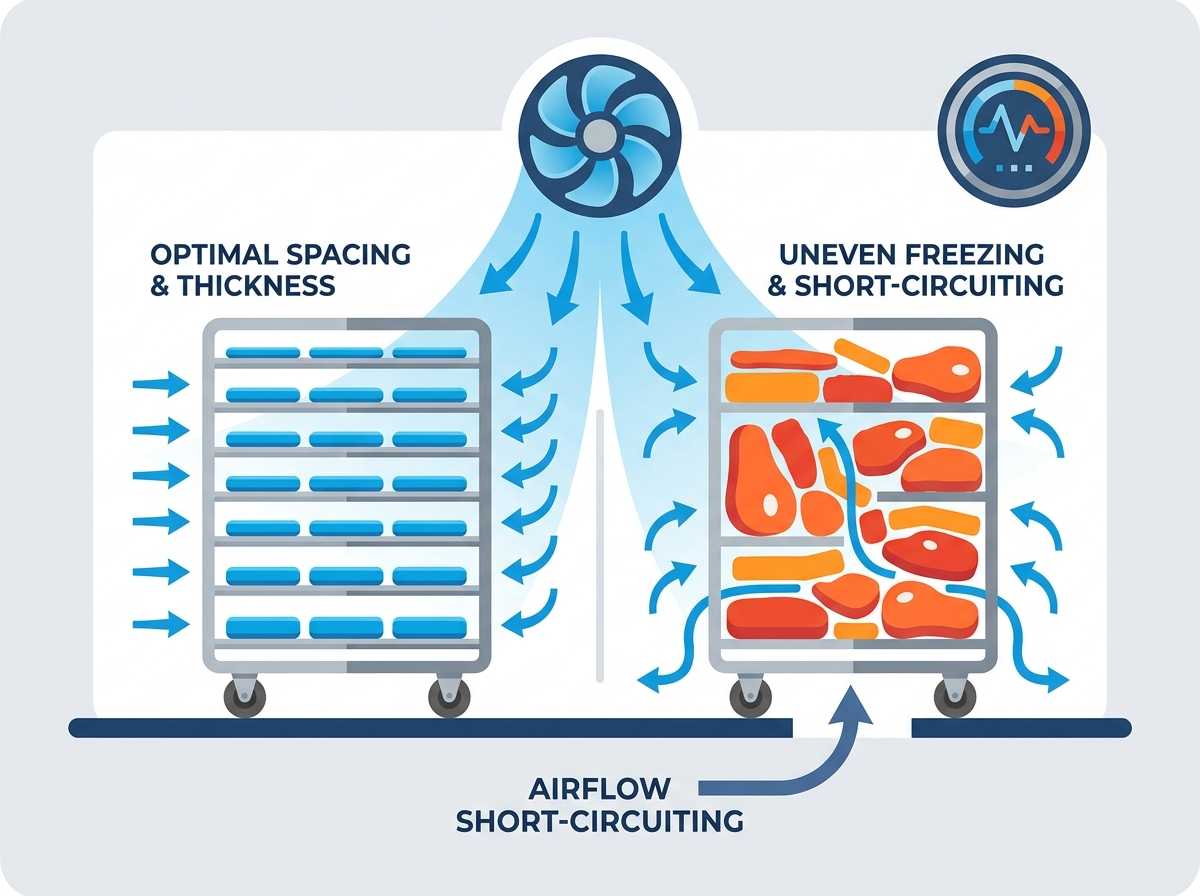
Airflow Follows the Path of Least Resistance: Unbaffled gaps around pallets or trolleys cause cold air to bypass the product entirely, leading to airflow short-circuiting and localized warm zones.
Spacing Dictates Heat Transfer: Utilizing engineered freezer spacers and enforcing strict trolley spacing protocols are mandatory for uniform convective heat transfer across all product surfaces.
Thickness Multiplies Dwell Time: Freezing time increases disproportionately with product thickness; standardized packaging and batching are critical for predictable cycle times.
Capacity Does Not Equal Efficiency: Upgrading compressor capacity will not solve uneven freezing if the internal airflow dynamics and plenum designs remain unoptimized.
Spoilage and Product Damage Risks: Uneven freezing is not just an energy issue; it directly causes localized product damage, large ice crystal formation, tissue rupture, and failure to meet regulatory HACCP standards.
The Physics of Uneven Freezing in an Air Blast Freezer
Convective Heat Transfer and the Boundary Layer
Every product entering a freezing chamber is surrounded by a thermal boundary layer. This microscopic layer of stagnant air acts as an insulator. It traps heat and slows the cooling process. High-velocity air is required to physically strip away this insulating layer. By disrupting the boundary layer, you accelerate convective heat transfer. Inadequate air velocity fails to break this barrier. This failure leads to localized microclimates where heat remains trapped around the product surface. We see this constantly in facilities that pack pallets too tightly against the walls.
To break the boundary layer, fans must generate enough static pressure to push air through the gaps. If the air velocity drops below 500 feet per minute, the boundary layer thickens. The product then relies on conduction rather than convection, which is far too slow for commercial operations. You end up with a frozen exterior and a soft, warm core.
The Core Thermodynamic Targets: Air Temperature vs. Air Distribution
Commercial blast freezing establishes a practical baseline for operation. Facilities typically aim to maintain air temperatures between -20°F and -30°F. However, achieving this temperature at the evaporator coil is insufficient. Maintaining the target temperature is useless if uniform distribution around every product surface is not achieved. Cold air must wash over the entire load evenly. Without uniform distribution, products on the perimeter freeze rapidly while internal cartons remain dangerously warm.
We often measure a 15-degree difference between the outer cartons and the center cartons on a poorly stacked pallet. The refrigeration system is doing its job, but the air distribution is failing. You cannot simply lower the thermostat to fix this. Lowering the setpoint wastes energy and causes severe freezer burn on the perimeter products while doing nothing for the center.
The Mechanics of Airflow Short-Circuiting
Short-circuiting represents a critical failure in fluid dynamics within commercial refrigeration. Cold air supplied by evaporator fans naturally seeks the lowest-pressure route back to the return. It behaves like water, flowing through empty spaces rather than pushing through dense obstructions. When unbaffled gaps exist, the air bypasses densely packed product zones entirely. The primary symptom is a rapid drop in return-air temperatures while core product temperatures remain high. The system registers that the room is cold, but the product itself is not freezing.
This happens when operators leave large gaps between trolleys or fail to pull the load all the way to the baffle wall. The high-velocity air shoots over the top of the load or down the wide aisles, completely ignoring the product. The compressor cycles off prematurely because the return air sensor reads -30°F, leaving the actual product at 20°F.
Critical Factor 1: Trolley Spacing and Freezer Spacers
The Role of Aerodynamic Freezer Spacers
Standard wooden pallets are designed for structural support, not thermal efficiency. Purpose-built freezer spacers feature aerodynamic profiles designed to facilitate airflow. These spacers create necessary horizontal channels between stacked cartons. High-velocity cold air uses these channels to penetrate the center of a palletized load. Improper spacer alignment blocks these pathways. When spacers are misaligned, airflow is choked, preventing cold air from reaching internal product surfaces and causing severe temperature discrepancies.
Using the right spacer profile matters. A 50mm spacer provides significantly better airflow than a 25mm spacer, especially for dense products like boxed beef or block-frozen seafood. The material also matters. High-density polyethylene (HDPE) spacers resist ice buildup and maintain their structural integrity under heavy loads, ensuring the air channels remain open throughout the cycle.
Calculating Optimal Gap Widths
Engineering the correct spacing between trolleys, walls, and ceilings is a precise science. You must leave adequate room for air to circulate without creating massive bypass channels. A standard recommendation involves leaving specific gap widths to maintain necessary static pressure. There is a constant trade-off between maximizing freezer capacity and maintaining uniform airflow. Packing a room too densely destroys static pressure. The air cannot move, and the freezing cycle stalls.
As a general rule, we recommend a 2-inch to 3-inch gap between trolleys in the direction of airflow. This allows enough room for air to enter the spacer channels without creating a low-pressure bypass zone. The gap between the top of the load and the ceiling baffle should be virtually zero. Any space above the load is a guaranteed short-circuit.
Common Loading Errors That Choke Airflow
Operational mistakes frequently sabotage equipment performance. Pushing trolleys flush against evaporator intakes restricts the air supply. Misaligning rows creates jagged channels that disrupt fluid dynamics. Mixing pallet heights within the same blast cycle creates massive voids where air escapes over the top of shorter loads. Blocked airflow forces the refrigeration system to run longer. This overworks compressor motors and accelerates mechanical wear on the entire air blast freezer system.
Failing to align freezer spacers vertically, which crushes cartons and blocks horizontal air channels.
Leaving partial pallets at the front of the airflow path, allowing air to dump over the top.
Positioning trolleys too far from the plenum wall, creating a massive bypass zone at the rear of the chamber.
Wrapping pallets in stretch film before the freezing cycle is complete.
Critical Factor 2: Product Thickness and Packaging Geometry
Center-Temperature Dynamics in Thick vs. Thin Profiles
The relationship between product thickness and freezing time is highly non-linear. According to Plank’s Equation principles, doubling the thickness of a product more than doubles the required freezing time. Heat must travel from the core to the surface, and thicker profiles present a longer thermal path. Mixing thick and thin products in a single cycle guarantees uneven results. Thin items will over-freeze and suffer freezer burn. Thick items will remain under-frozen at the core.
If you run a mixed load, you are forced to base the cycle time on the thickest product. This wastes energy and damages the thinner products. Standardizing batch profiles is the only way to achieve predictable, efficient cycles. A 4-inch thick carton of chicken breasts will behave entirely differently than a 2-inch thick carton of fish fillets.
The Insulating Effects of Packaging Materials
Packaging materials inherently resist heat transfer. Corrugated cartons, thick shrink wrap, and trapped air pockets act as thermal insulators. They possess distinct R-values that slow the cooling process. Mitigating packaging insulation requires strategic adjustments. Facilities often use perforated cartons to allow direct air contact with the product. Where compliant with safety regulations, freezing products prior to final packaging drastically reduces dwell times.
Packaging Material
Thermal Resistance Impact
Airflow Penetration
Recommended Mitigation
Standard Corrugated Carton
High
Poor
Use perforated designs
Heavy Shrink Wrap
Medium
None
Wrap post-freezing if possible
Plastic Totes (Vented)
Low
Excellent
Ensure vents align with spacers
Wax-Coated Boxes
Very High
None
Increase air velocity and cycle time
Quality Degradation: Product Damage and Drip Loss
Slow, uneven freezing physically damages cellular structures. When temperatures drop slowly, large ice crystals form inside the product. These jagged crystals puncture cell walls, causing cellular rupture. Upon thawing, the damaged cells release moisture, resulting in high drip loss. Uneven freezing rates directly impact product texture and yield weight. The final product suffers in quality, and the facility loses money on reduced yield and compromised shelf-life stability.
We see this frequently in the seafood industry. A slow freeze results in a mushy texture upon thawing. The weight lost through drip loss directly impacts the bottom line, as the product is sold by weight. Fast, uniform freezing creates microscopic ice crystals that leave the cellular structure intact.
Standardizing Batch Profiles for Predictable Dwell Times
Operational consistency demands standardized batch profiles. Grouping products by similar geometry and thermal mass is an absolute necessity. You cannot effectively freeze a mixed load of thin fillets and thick roasts simultaneously. Success criteria for batch standardization involve achieving uniform core temperatures across all pallets at the end of a cycle. Predictable dwell times allow facilities to optimize turnover rates and maximize daily throughput.
Implement a strict sorting protocol on the loading dock. Group products by thickness and packaging type before they ever reach the freezing chamber. This simple administrative step eliminates the guesswork for the freezer operators and ensures every cycle runs at maximum efficiency.
Critical Factor 3: Mitigating Short-Circuiting with Plenum and Baffle Design
Identifying Bypass Zones in Your Current Setup
Locating dead zones requires a systematic airflow audit. Technicians use anemometers to measure air velocity across the product face. Smoke tests provide a visual representation of high-velocity bypass channels. Common bypass areas exist above the load, beneath the trolleys, and between the load and the freezer doors. Identifying these zones is the first step in correcting fluid dynamics and forcing air through the product.
Position smoke generators at the evaporator discharge.
Observe the initial flow path to identify major bypass channels over the top of the load.
Use an anemometer to measure velocity at the center of the pallets.
Check the floor-level gaps beneath the trolleys for escaping air.
Implementing Baffling, False Ceilings, and Air Deflectors
Structural solutions force air through the product rather than around it. Adjustable baffles block the empty spaces above shorter pallets. Heavy-duty curtains seal the gaps between the load and the walls. False ceilings lower the overhead clearance, maintaining static pressure across the product face. By sealing these gaps, you eliminate the path of least resistance. The cold air is forced to travel through the freezer spacers, cooling the product core.
A simple drop-down canvas baffle can reduce cycle times by 20%. If the air cannot go over the load, it must go through it. We install rigid deflectors on the side walls to push air back toward the center aisles. These physical barriers are inexpensive and highly effective at correcting poor fluid dynamics.
Common Structural Design Flaws vs. Loading Errors
It is vital to differentiate between systemic equipment design flaws and day-to-day operational errors. Poor fan placement or inadequate static pressure are structural flaws requiring engineering intervention. Conversely, pushing pallets too close together or omitting spacers are operational errors. Addressing loading errors requires training. Fixing structural flaws requires mechanical modification. Both must be resolved to achieve uniform temperature distribution.
You can identify a structural flaw if the airflow is poor even when the room is loaded perfectly. If the fans lack the static pressure capability to push air through a properly spaced load, you need mechanical upgrades. If the airflow is fine during a test run but fails during production, you have a loading error problem.
Fan Placement and Variable Frequency Drives (VFDs)
Evaporator fan placement dictates the initial trajectory of the cold air. Fans must be positioned to push or pull air evenly across the entire chamber. Integrating Variable Frequency Drives (VFDs) offers significant operational advantages. VFDs adjust fan speed dynamically as the product freezes. High speeds are used initially to break the boundary layer. Speeds are reduced once the surface freezes, optimizing energy use without sacrificing airflow integrity.
Running fans at 100% capacity for the entire cycle wastes massive amounts of electricity. Once the outer layer of the product is frozen, the heat transfer rate slows down naturally. The VFD allows you to dial back the fan speed, saving energy while maintaining enough airflow to finish freezing the core.
Evaluating Upgrades: Retrofitting vs. Replacing Your Air Blast Freezer
Assessing the Cost of Poor Temperature Distribution
Calculating the true cost of uneven freezing requires looking beyond the electricity bill. Product yield loss from drip loss directly reduces revenue. Energy waste from extended run times inflates operational expenses. Extended labor hours are required to manage unpredictable cycles. Furthermore, localized warm zones introduce potential regulatory compliance failures. When these costs are aggregated, the financial justification for system upgrades becomes clear.
If you are losing 3% of your product weight to drip loss on a 10,000-pound load, that is 300 pounds of lost revenue per cycle. Multiply that by the number of cycles per year, and the cost of poor airflow becomes staggering. Upgrading baffles and spacers pays for itself very quickly under these conditions.
High-Impact Retrofit Solutions
Existing systems often benefit from cost-effective retrofits. Installing automated baffles dynamically adjusts to different load heights. Upgrading to high-flow freezer spacers immediately improves internal pallet airflow. Implementing strict floor-marking systems guides forklift operators, ensuring precise trolley placement. These retrofits address fluid dynamics directly, often resolving uneven freezing without requiring a complete system overhaul.
Floor markings are the cheapest and most effective retrofit. Paint bright yellow lines on the floor to show operators exactly where to place the trolleys. Add physical bump stops bolted to the floor to prevent them from pushing the load too far back. Take the guesswork out of the loading process.
When to Specify a Custom-Engineered System
Retrofits fail when the underlying infrastructure is fundamentally flawed. Undersized evaporators cannot generate the required cooling capacity. Structurally inadequate room dimensions prevent proper airflow routing regardless of baffling. When retrofits are insufficient, a new build is required. Evaluation dimensions for a custom system include computational fluid dynamics (CFD) modeling, custom plenum designs, and automated loading systems to eliminate human error.
If your room is too short to accommodate proper false ceilings, or if the evaporator coils are constantly freezing over because they lack the surface area to handle the moisture load, you need a new system. A custom build allows you to design the room around the product, rather than forcing the product into a generic room.
Implementation Risks and Operational Mitigation
Overcoming Operator Resistance to Loading Protocols
The human element often undermines engineered solutions. Operators frequently prioritize loading speed over precise spacing. They may skip using spacers or ignore floor markings to finish a shift faster. Mitigation strategies must focus on accountability and ease of use. Install visual floor guides and physical bump-stops to make correct placement intuitive. Standardize SOPs and tie them directly to QA metrics to ensure compliance.
Training is not a one-time event. You must continuously audit the loading process. Have the QA team inspect the chamber before the doors are closed. If the spacers are missing or the baffles are not deployed, the cycle does not start. Enforce the protocols strictly.
Maintenance Schedules for Evaporator Coils and Fans
Mechanical neglect exacerbates uneven freezing. Frost build-up on evaporator coils restricts airflow and insulates the cooling fins. This drastically reduces the system's ability to remove heat from the room. Establish a baseline defrost and maintenance schedule. Regularly inspect fans for proper operation and clear ice from the plenums. Consistent maintenance ensures the mechanical components support the optimized airflow design.
Check the fan blades for ice accumulation. Unbalanced fan blades vibrate violently and will eventually destroy the motor bearings. Ensure the defrost cycles are long enough to completely clear the coils, but not so long that they introduce unnecessary heat into the room.
Conclusion
Raw cooling power cannot overcome poor fluid dynamics. Successful operation is a function of managed airflow and disciplined loading. Upgrading compressors will not fix short-circuiting. You must address the physical path the air takes through the chamber.
The hierarchy of interventions is clear. Start with operational loading protocols and high-quality spacers. Progress to baffling and airflow management to eliminate bypass zones. Finally, consider mechanical capacity upgrades if the optimized airflow still falls short.
Initiate a comprehensive facility airflow audit using anemometers and smoke tests to locate bypass zones.
Implement strict floor-marking systems and physical bump stops to enforce proper trolley spacing.
Standardize batching protocols to ensure uniform product thickness in every cycle.
Install adjustable baffles to seal gaps above and around the pallet loads.
Consult with a refrigeration engineer to model potential VFD or fan upgrades.
FAQ
Q: What is the ideal air velocity for an air blast freezer?
A: The standard range is 500 to 1,000 feet per minute (FPM) over the product surface. Higher velocities yield diminishing returns on heat transfer while significantly increasing fan energy consumption.
Q: Why does airflow short-circuiting happen in blast freezing?
A: Air behaves like a fluid, taking the path of least resistance. It flows through empty spaces around pallets rather than forcing its way through dense product layers, leaving the core uncooled.
Q: How do freezer spacers improve freezing times?
A: Spacers create horizontal voids between stacked cartons. This allows high-velocity cold air to reach the center of the pallet, drastically reducing overall cycle time and ensuring uniform temperatures.
Q: What is the recommended air temperature for commercial blast freezing?
A: Standard commercial practice requires air temperatures between -20°F and -30°F. This ensures rapid crystallization and minimizes cellular damage to the product.
Q: How does product thickness affect blast freezing time?
A: Freezing time increases roughly in proportion to the square of the product thickness. This non-linear relationship makes product geometry a primary bottleneck in cycle efficiency.
Q: Can uneven freezing cause food safety issues?
A: Yes. Localized warm zones can allow bacterial growth and enzymatic degradation. This leads to spoilage, reduced shelf life, and failure to meet HACCP critical limits.