You are here:Home » Blogs » Industry Hotspots » How to Compare Tunnel Blast Freezer Quotations: Capacity, Refrigeration Duty, Room Size, and Scope of Supply
How to Compare Tunnel Blast Freezer Quotations: Capacity, Refrigeration Duty, Room Size, and Scope of Supply
Views: 0 Author: Site Editor Publish Time: 2026-08-07 Origin: Site
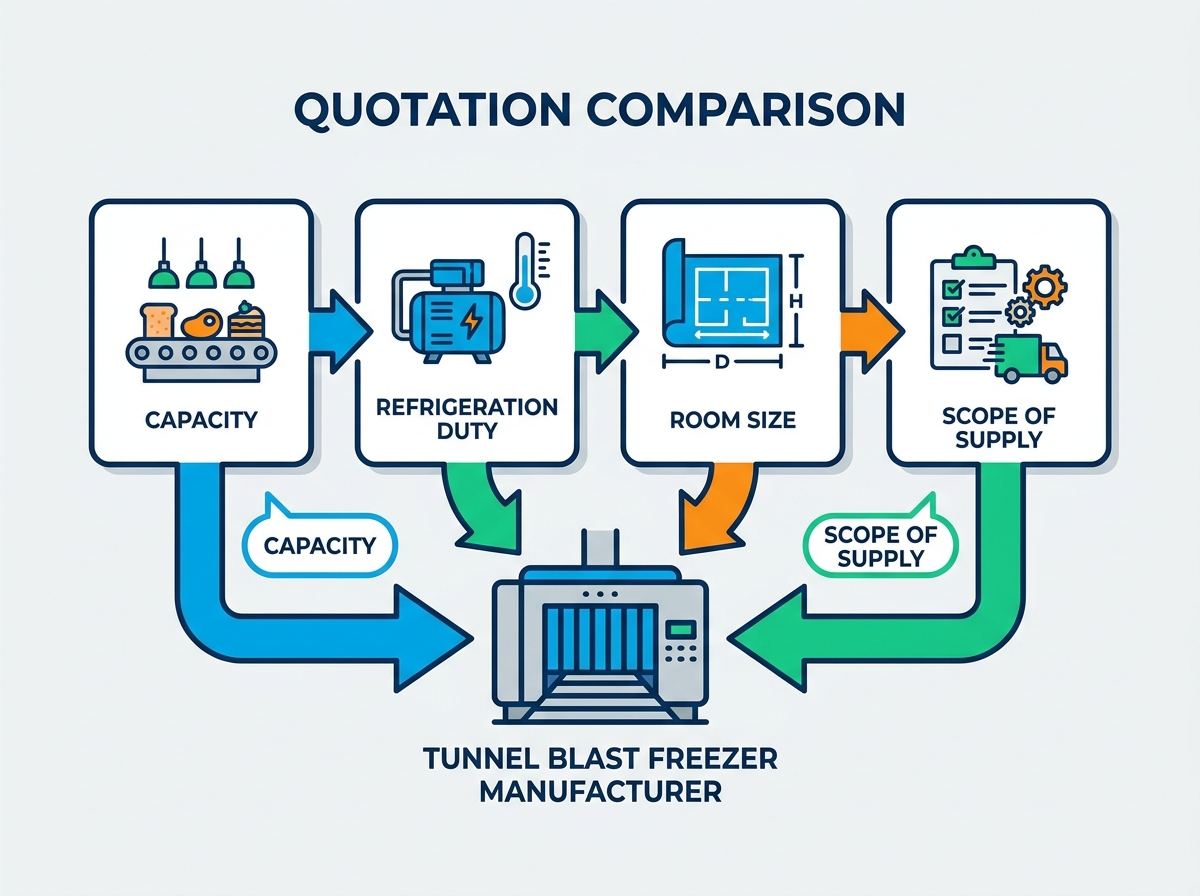
Reviewing industrial refrigeration proposals reveals a harsh procurement reality. No two equipment quotations look identical. Vendors format technical specifications differently, making side-by-side comparisons inherently flawed and financially risky. Accepting a misaligned quotation directly leads to production bottlenecks, excessive energy consumption, inadequate core temperature reduction, or unexpected out-of-pocket installation costs down the line. You need a standardized evaluation framework to normalize vendor proposals across four critical pillars: capacity, refrigeration duty, physical dimensions, and scope of supply.
This technical guide provides the exact methodology required to strip away marketing claims and evaluate the raw engineering data within competing proposals. You will learn how to identify hidden exclusions, verify thermal load calculations, and ensure the proposed system actually meets your production throughput requirements. By applying these principles, you can confidently select the right equipment without falling into common procurement traps.
Capacity is dynamic, not static: Nominal freezing capacity must be adjusted for specific product entry temperatures, packaging types, and target core temperatures.
Refrigeration duty dictates performance: A lower-priced quote often masks an undersized compressor or inadequate evaporator coil surface area, leading to longer freeze times.
Airflow requires volume: Physical room size must account for aerodynamic clearances, not just the physical footprint of the product conveyors or racks.
Scope of supply defines total cost of ownership: Explicitly mapping inclusions versus exclusions (e.g., electrical panels, refrigerant charge, commissioning) is mandatory before selecting a tunnel blast freezer manufacturer.
The Apples-to-Oranges Trap in Procurement
A successful quotation evaluation achieves a normalized long-term operational model rather than a baseline capital expenditure comparison. Evaluating proposals solely on the bottom-line price ignores the mechanical realities of industrial freezing. You must force vendors to quote against identical operational parameters to establish a true baseline. Without a standardized Request for Quotation, one vendor might quote a heavy-duty system built for continuous maximum load, while another quotes a lighter commercial system that will struggle during peak summer months.
When you review bids, you are looking for engineering alignment. If Vendor A proposes a 150kW cooling capacity and Vendor B proposes 90kW for the exact same product throughput, someone has miscalculated the heat load. You cannot simply average the two or pick the cheaper option. You have to dig into the psychrometric charts and thermal assumptions driving those numbers.
The Cold Room vs. Blast Freezer Trap
Buyers frequently encounter deceptively low quotes that utilize standard, low-velocity cold room storage components instead of heavy-duty, high-velocity blast freezing systems. A standard holding freezer simply maintains the temperature of already frozen goods. It lacks the evaporator surface area and fan velocity required to pull heat out of fresh products rapidly. Installing holding room equipment for a freezing application guarantees failure. The product will freeze too slowly, degrading cellular structure and causing massive drip loss upon thawing.
Specification
Standard Cold Room
Industrial Blast Freezer
Airflow Velocity
Low (Gentle circulation)
High (Rapid heat extraction)
Evaporator Fin Spacing
4mm to 6mm
10mm to 12mm (Prevents rapid icing)
Operating Temperature
-18°C to -22°C
-35°C to -45°C
Primary Function
Temperature maintenance
Rapid core temperature reduction
Freezing Methodology Comparison
You must assess whether the quotation proposes a batch-based static freezer or a continuous inline tunnel blast freezer. Continuous tunnel technology offers superior return on investment regarding food quality. Rapid continuous freezing minimizes ice crystal formation, preserves cell structure, and drastically reduces drip loss during defrosting. Static batch freezers require manual loading and unloading, increasing labor costs and exposing the product to inconsistent airflow depending on where it sits on the rack.
In a static room, the product closest to the evaporator fans freezes much faster than the product hidden in the back corners. This creates inconsistent batch quality. A continuous system moves every single product through the exact same airflow profile, guaranteeing uniform core temperatures at the discharge end.
Solution Categories and Standardization
Differentiate between turnkey solutions, equipment-only supply, and hybrid integrator models. A turnkey provider handles everything from structural insulated panels to final commissioning. An equipment-only supplier ships the machinery, leaving you to source local contractors for piping, electrical work, and panel installation. Establish the baseline requirement for your project early to ensure all vendors are quoting the exact same scope of work.
If you accept an equipment-only bid thinking it is a turnkey solution, you will face massive unexpected costs hiring local pipefitters, electricians, and refrigeration technicians to assemble the system on site.
Pillar 1: Scrutinizing Freezing Capacity and Throughput Realities
Evaluating capacity requires looking past the bold numbers on the front page of the proposal. Throughput is highly dependent on the physical characteristics of your specific product. A machine rated for 1,000 kg/hr on one product might only achieve 600 kg/hr on another.
Nominal vs. Operational Capacity
A massive discrepancy often exists between a manufacturer's stated nameplate capacity and your actual operational throughput. A vendor might advertise a system capable of freezing 1,000 kilograms per hour. However, that rating might be based on freezing small, bare peas. If you are freezing large, thick cuts of meat, your throughput will be significantly lower. Product density, water content, and specific heat capacity fundamentally alter the actual freezing time. High water content requires more energy to push through the latent heat of fusion.
Water expands when it freezes. The phase change from liquid to solid requires a massive amount of refrigeration energy. Products with 80% water content demand significantly larger compressors than products with 40% water content, even if the total hourly weight is identical.
Evaluating Product-Specific Variables
Assess exactly how vendors account for entry temperature and target core temperature. Dropping a product from +85°C cooked directly to a standard -18°C core requires vastly more refrigeration duty than dropping a +4°C chilled product to the same target. Furthermore, vendors sometimes assume bare product in their calculations. If your reality includes insulating packaging like corrugated boxes or thick poly bags, the freezing time extends dramatically.
Identify the exact entry temperature of the product as it hits the belt.
Determine the required core temperature at the discharge point.
Document the specific heat capacity of the product above and below freezing.
Calculate the latent heat of fusion based on the product's water content.
Factor in the thermal resistance of any primary or secondary packaging.
Packaging acts as a thermal barrier. Failing to account for it in the design phase leads to undersized equipment. A corrugated box traps insulating air around the product, forcing the refrigeration system to work harder and longer to penetrate to the core.
Freezing Time and Physical Tunnel Length
The calculated freezing time dictates the required belt speed and the physical length of the enclosure to meet the target hourly throughput. If a product requires 45 minutes to freeze completely, and you need to process 2,000 kilograms per hour, the belt must be long enough to hold 1,500 kilograms of product at any given moment while moving at a speed that keeps the product inside for exactly 45 minutes.
Shorter tunnels require slower belt speeds, which directly reduces your hourly throughput. If a vendor quotes a significantly shorter footprint than competitors for the same throughput, they are likely underestimating the required retention time. This results in product exiting the system with a soft, unfrozen core.
Safety Margins and Scalability
Balancing the upfront investment of over-sizing the equipment today versus the operational bottleneck of under-sizing it for future production line speeds is a critical engineering decision. Verify that quotes include a 10% to 15% capacity safety margin. This buffer accounts for mechanical wear over time, fouling of the evaporator coils, and ambient temperature fluctuations during peak summer months.
A system designed with zero margin will fail to meet production targets the moment conditions deviate from the ideal laboratory baseline. When evaporator coils build up frost during a long production shift, their heat transfer efficiency drops. A properly sized safety margin ensures the system maintains target temperatures even when the coils are partially frosted.
Pillar 2: Assessing Refrigeration Duty and Thermal Load
The refrigeration duty is the engine of your freezing system. Understanding how this number is calculated prevents you from buying an underpowered system. You must demand to see the vendor's heat load calculation sheets.
Deconstructing the Total Heat Load Calculation
Break down the refrigeration duty into its core components: product load, transmission load, infiltration load, and equipment load. The product load is the energy required to freeze the food. Transmission load accounts for heat bleeding through the insulated panels. Infiltration load covers warm air entering through openings or conveyors. Equipment load includes the heat generated by the internal fan motors.
Heat Load Component
Description
Impact on Sizing
Product Load
Energy to cool and freeze the actual food items.
Largest factor; dictates baseline compressor size.
Transmission Load
Heat entering through walls, ceiling, and floor.
Depends on panel thickness and ambient factory temp.
Infiltration Load
Warm air entering through conveyor openings.
Requires air curtains or vestibules to minimize.
Equipment Load
Heat generated by evaporator fan motors inside the room.
High-velocity fans add significant heat that must be removed.
Instruct evaluators to check if competing quotes are based on the same ambient temperature assumptions. Assuming a 25°C factory floor yields a much smaller required compressor than assuming a 35°C unconditioned space. If a vendor uses an artificially low ambient temperature in their calculations, their quoted price will look attractive, but the system will fail during the summer.
Air Temperature vs. Core Temperature Targets
Verify that the refrigeration load calculations are designed to maintain a consistent air temperature, typically between -35°C and -40°C. This extreme cold is necessary to ensure the product's core reaches -18°C within the specified time frame. If a vendor quotes a system designed to maintain only -25°C air temperature, the core freezing process will take significantly longer, reducing your overall factory throughput.
The delta between the air temperature and the target core temperature drives the speed of heat transfer. A larger delta forces heat out of the product faster. Shrinking that delta to save money on compressor sizing ruins production efficiency.
Compressor and Evaporator Sizing
Analyze the specified compressor technology and its impact on part-load efficiency. Two-stage screw compressors generally offer better longevity and efficiency for massive industrial loads compared to standard reciprocating compressors. Screw compressors handle large volumes of low-pressure suction gas much better than reciprocating models, making them ideal for -40°C applications.
Evaluate the evaporator coil specifications closely. Look at the fin spacing. Tighter fins offer more surface area but ice up much faster, requiring frequent defrost cycles. For blast freezing, you want wide fin spacing, typically 10mm to 12mm. Review the defrosting mechanisms proposed, comparing the speed of hot gas defrost against the simplicity of electric defrost heaters. Hot gas defrost is faster and more energy-efficient for large industrial systems.
Energy Efficiency Trade-offs
Compare the upfront investment of variable frequency drives on fans and compressors against long-term electrical savings. VFDs allow the system to ramp down power consumption when the production line is running at partial capacity. While they increase the initial purchase price, the reduction in monthly utility bills usually pays for the drives within the first two years of operation.
Running evaporator fans at 100% speed when the belt is only half full wastes massive amounts of electricity. VFDs give the PLC the ability to match fan speed to the actual product load in real time.
Pillar 3: Sizing the Enclosure: Room Dimensions vs. Usable Space
Physical dimensions matter beyond just fitting the equipment inside your facility. The size of the enclosure directly impacts airflow and freezing efficiency. A poorly designed room will choke the refrigeration system.
Footprint Constraints and Airflow Dynamics
Clarify the difference between external dimensions, internal volume, and actual usable freezing space. Undersized internal dimensions restrict airflow return paths. This restriction causes the Coanda effect, where high-velocity air bypasses the product entirely and clings to the walls and ceiling. When air bypasses the product, freezing efficiency plummets, even if you have installed a massive compressor and adequate refrigeration duty.
Air takes the path of least resistance. If the space between the conveyor and the wall is too tight, the air will not push through the product layers. It will shoot around the sides, leaving the center of the belt completely unfrozen.
Product-to-Volume Ratio Alignment
Assess if the proposed dimensions maintain a balanced ratio between the product volume and the internal air volume. You need enough space for air to circulate, but excess dead space results in wasted cooling power and inefficient air distribution. The enclosure should tightly wrap around the aerodynamic requirements of the fans and the conveyor system without creating massive empty voids that need to be kept at -40°C.
Every cubic meter of empty space inside the enclosure represents wasted energy. The design must channel the air directly through the product zone using baffles and plenums, rather than just blowing cold air into a large empty box.
Insulation Thickness and Panel Specifications
Compare panel thickness and material. Polyisocyanurate (PIR) and polyurethane (PU) panels are standard. For blast freezing applications, panels typically range from 150mm to 200mm thick, compared to the standard 100mm used for basic cold storage. Evaluate the density of the insulation and the cam-lock joining mechanisms proposed.
Check the specified panel thickness (minimum 150mm for -40°C).
Verify the foam density (typically 40-42 kg/m³ for structural integrity).
Inspect the joint design (cam-locks provide tighter seals than slip joints).
Ensure vapor barriers are properly specified for all panel seams.
Poorly designed joints lead to thermal bridging, where heat leaks into the room, causing massive ice buildup on the walls and ceiling. This ice eventually damages the panels and creates a severe hygiene risk.
Floor Construction and Thermal Breaks
Assess vendor proposals for floor insulation. Operating at -40°C will eventually freeze the ground beneath the facility if not properly insulated. This causes frost heave, which can literally crack your concrete foundation and destroy the building. Look for proposals that include high-density floor insulation and sub-floor heater mats or glycol heating loops to prevent the ground from freezing.
Verify the load-bearing capacity of the floor construction to handle heavy industrial traffic and machinery weight. The floor must support the static weight of the conveyor system and the dynamic weight of maintenance personnel and cleaning equipment.
Pillar 4: Defining the Scope of Supply
The most common source of budget overruns is a poorly defined scope of supply. You must know exactly where the vendor's responsibility ends and yours begins. Do not assume anything is included unless it is explicitly written in the contract.
Mapping Inclusions and Exclusions
Create a strict checklist for comparing quotes. Identify who supplies the primary refrigerant charge. Determine who provides the interconnecting copper or stainless steel piping between the compressor skid and the evaporator. Clarify who handles the primary electrical feeds from your factory's main breaker to the equipment control panel.
Identify common hidden exclusions like structural steel supports for ceiling-mounted evaporators, crane hire for lifting heavy compressors into place, and the costs associated with factory acceptance testing. If a vendor excludes the refrigerant charge, you could be hit with a massive bill to fill a large industrial system with ammonia or synthetic refrigerants.
Controls, Sensors, and Automation Integration
Evaluate the proposed PLC and HMI systems. Determine if the quote includes basic thermostatic on/off control, or advanced recipe-based freezing profiles that adjust belt speed and fan velocity based on the specific product being run. Assess integration capabilities with your existing plant SCADA or ERP systems.
Modern food processing requires strict compliance and traceability reporting. Your freezing equipment must be able to export temperature logs automatically. If the vendor supplies a closed, proprietary control system, you will struggle to integrate it with your central factory monitoring software.
Installation, Commissioning, and Warranty
Scrutinize the warranty terms provided by the tunnel blast freezer manufacturer. Distinguish carefully between parts-only warranties and full parts-and-labor warranties. A parts-only warranty leaves you paying massive hourly rates for specialized refrigeration technicians if a component fails.
Verify the exact scope of commissioning. Does the vendor simply turn the machine on for a dry run, or do they mandate a fully loaded product performance test to prove the quoted capacity in real-world conditions? A dry run proves the fans spin and the compressor runs. A fully loaded test proves the system actually freezes your product to the required core temperature at the specified hourly rate.
Conclusion
The lowest quoted price is frequently the most expensive option once operational inefficiencies, energy costs, and scope gaps are calculated. Evaluating proposals requires a strict focus on engineering realities rather than marketing claims. To move forward effectively, implement the following steps:
Discard any quotes that fail to provide transparent heat load calculations or refuse to detail their ambient temperature assumptions.
Eliminate vendors who will not guarantee core temperature reduction times based on your specific product and packaging profiles.
Consolidate the missing data points from your current proposals and issue a standardized technical clarification document to the remaining vendors.
Demand a performance guarantee contract that ties final payment to a successful, fully loaded product test on your factory floor.
FAQ
Q: What is the difference between a cold room and a blast freezer?
A: A cold room is designed for long-term storage, maintaining the temperature of already frozen goods using low-velocity airflow. A blast freezer is engineered for rapid temperature reduction, utilizing high-velocity airflow and significantly larger refrigeration capacity to drop fresh product core temperatures to -18°C or lower quickly.
Q: What is the difference between a static blast freezer and a tunnel blast freezer?
A: Static freezers process products in batches, requiring manual loading onto racks. Tunnel freezers provide continuous inline processing via conveyor belts. Tunnel systems handle higher throughput volumes, minimize drip loss, and improve overall product quality through faster, more consistent heat transfer.
Q: How do I calculate the required capacity for a tunnel blast freezer?
A: Capacity calculations require the product mass per hour, the specific heat capacity of the food, entry and exit temperatures, and the required freezing time. You must also factor in a 10% to 15% safety margin and account for the thermal resistance of any product packaging.
Q: Why do quotes from different manufacturers have vastly different refrigeration duties?
A: Discrepancies arise from differing engineering assumptions. Vendors may assume different ambient temperatures, ignore product packaging insulation values, exclude fan motor heat loads, or miscalculate the internal air volume sizing required for proper airflow.
Q: What is a standard insulation thickness for a tunnel blast freezer?
A: Standard insulation for these applications requires 150mm to 200mm high-density PU or PIR panels. This thickness is necessary to prevent thermal bridging and manage the extreme internal operating temperatures of -35°C to -40°C efficiently.