The best iqf freezing machine depends on your business. You should think about how big your business is. You also need to look at what you freeze and how much money you want to spend. Think about how much you make, how delicate your products are, and how much it costs to start. You should also think about how much it costs to run and how good you want your products to be. Many industries use IQF machines for different things. They use them for fruits, vegetables, seafood, meat, and poultry. They also use them for ready-to-eat meals and medicine. The table below shows common business sizes and what they freeze:
Business Size | Product Types |
Large-scale manufacturers | Fruits, vegetables, seafood, meat, poultry, ready-to-eat meals |
Mid-sized food processors | Fruits, vegetables, seafood, meat, poultry, ready-to-eat meals |
Healthcare sector | Pharmaceutical and biotech products |
Other sectors | Pet food, baked goods, snacks |
This guide helps you find the best technology fast.
Key Takeaways
Pick the best IQF freezing machine for your business size and product. Mechanical systems work well for big amounts of food. Cryogenic systems are better for soft foods.
Mechanical IQF freezing costs less in the long run. It may cost more at first. It uses less energy and freezes big batches well.
Cryogenic IQF freezing freezes food very fast. It keeps food quality and texture good. It works best for soft foods like berries and seafood.
Think about how much each system costs to run over time. Mechanical systems do not need to buy gases often. Cryogenic systems need to buy cold gases all the time.
Look at what you need to freeze. Think about your food types, your money, and if you want your business to grow later.
IQF Freezing Machine Basics
What Is IQF
You may hear the term IQF in many food processing plants. IQF stands for individual quick freezing. This food processing technique freezes each piece of food separately. You do not get clumps or blocks. Instead, you get individual quick frozen items that keep their shape and quality. IQF technologies use special machines to make this possible.
A typical iqf freezing machine has several key parts. Here is a table to help you understand the main components:
Component | Description |
IQF Conveyor belt | Moves products in and out of the freezing area. Made from stainless steel, food-grade plastic, or aluminum. |
IQF Conveyor belt drive | Uses an electric motor. You can adjust speed and torque with a touch screen. |
Air circulation fans | Blows cold air over the food to freeze it quickly. |
IQF Evaporator | Cools the air. Made from aluminum, steel, or copper. |
You will find iqf freezing in many food freezing systems. It works well for fruits, vegetables, seafood, and meat. You can also use it for ready meals and even some medicines.
Why Freezing Method Matters
The way you freeze food changes its quality. IQF keeps each piece separate. Block freezing sticks everything together. Here are some key differences:
IQF freezes each piece on its own. You keep the texture, flavor, and nutrition.
Block freezing makes a solid mass. You may lose quality and have trouble separating portions.
IQF stops large ice crystals from forming. Your food stays firm and fresh. Block freezing can cause freezer burn and mushy texture.
Freezing also helps you keep food safe. It slows down germs that spoil food. If you use the right method, you keep the taste and smell. Blanching vegetables before freezing helps lock in nutrients.
Fast freezing makes small ice crystals. Your food stays firm and tasty.
Slow freezing makes big ice crystals. Your food may get soft and lose nutrients.
IQF technologies give you better results than old methods. You get high-quality products that look and taste fresh. Many experts say freezing is the best way to keep food quality over time compared to canning or drying.
Mechanical IQF Freezing
How It Works
A mechanical IQF freezing machine uses a refrigeration cycle to freeze food fast. First, a compressor pushes refrigerant gas to a high pressure. The gas then moves to a condenser and cools down. It turns into a liquid in this step. Next, the liquid goes through an expansion valve. The valve lowers the pressure and controls the flow. The liquid refrigerant enters the evaporator. Here, it takes heat from the food. This makes the food freeze quickly. This method is good for freezing lots of food at once. It also gives you steady results.
Component | Function |
Compressor | Compresses refrigerant gas to increase pressure. |
Condenser | Cools and condenses gas into a liquid. |
Expansion Valve | Reduces pressure and controls refrigerant flow. |
Evaporator | Absorbs heat from food, causing quick freezing. |
Mechanical freezer designs use air impingement or an iqf fluidized bed freezer. These keep food pieces apart. This helps you freeze each piece by itself and stops clumping.
Pros and Cons
Mechanical IQF freezing has many good points, but there are some downsides too.
Advantages of Mechanical IQF Freezing Machines | Disadvantages of Mechanical IQF Freezing Machines |
Works well in many situations | Higher initial investment than cryogenic systems |
Air impingement keeps products separate | Uses ammonia, which can be hazardous |
Supports high throughput | Longer freezing times can affect product quality |
Tip: If you want to save energy and freeze big batches, mechanical freezing is a smart pick.
Cost and Energy
Mechanical IQF freezing costs more to set up at first. The average cost to install is about $510,000. Each year, it costs around $165,530 to run. That is about $1.12 for every pound you freeze. These machines use less energy than regular quick-freezing or cryogenic systems. Air pressure technology helps save energy. This makes them a good choice if you want to spend less on freezing over time.
Cost Type | Amount |
Total Investment (Installed) | $510,000 |
Operating Cost - $/YR | $165,530 |
Unit Operating Cost - /Lb. | $1.12 |
Freezing Technology | Energy Efficiency Comparison |
Mechanical IQF Freezers | More energy efficient than conventional quick-freezing equipment and cryogenic systems due to air pressure usage. |
Conventional Quick-Freezing | Less energy efficient than IQF machines; operates on a conventional refrigeration cycle. |
Cryogenic Systems | Uses large amounts of refrigerant, making it less energy efficient compared to IQF machines. |
Liquid Nitrogen Freezers | More energy efficient as they do not rely on mechanical compressors. |
Product Quality
Mechanical IQF freezing helps keep your food fresh and nice looking. Fast freezing keeps the texture, taste, and nutrients. You can freeze fruits, vegetables, and seafood without them sticking together. This method freezes the outside first, then the inside. This makes the food better than block freezing or slow freezing. Mechanical IQF freezing is good for foods that need to stay high quality.
IQF lets you freeze each piece on its own.
Foods like berries and shrimp do not stick together.
You keep the taste and nutrition after freezing.
If you want to freeze food fast and get good results, mechanical IQF freezing is a strong choice for your business.
Cryogenic IQF Freezing
How It Works
A cryogenic IQF freezing machine freezes food very quickly. It uses very cold gases like liquid nitrogen or liquid carbon dioxide. These gases make the temperature drop fast. Each piece of food freezes by itself. There are different machines for this process. Some examples are straight tunnels, flight tunnels, submerged tunnels, cabinets, and spiral freezing systems. All these machines use cold gases to keep food pieces apart. They also help freeze lots of food at once.
Key Equipment | Description |
Straight Tunnel | Freezes food fast with cold gases. |
Flight Tunnel | Uses a conveyor to freeze food all the time. |
Submerged Tunnel | Dips food in cold liquid for quick freezing. |
Cabinet | Freezes small amounts of food in a closed space. |
Spiral Freezing System | Uses a spiral belt to save space and freeze more food. |
Low-Temperature Gases | Uses liquid nitrogen or carbon dioxide to freeze food instantly. |
Pros and Cons
Cryogenic freezing has many good points, but there are some things to watch out for. This method keeps food tasting good and looking nice. It also keeps the nutrition in the food. Fast freezing stops big ice crystals from forming. This helps food stay fresh. But you need to be careful about freezer burn and food drying out. Good packaging is important to keep food safe.
Benefits | Limitations |
Keeps food texture and flavor | Must keep food safe and stop spoilage |
Holds on to nutrients | Need to watch for freezer burn and dryness |
Stops big ice crystals from forming | Must use the right packaging for IQF foods |
Tip: Cryogenic systems are best for soft foods and foods that need to be top quality.
Cost and Energy
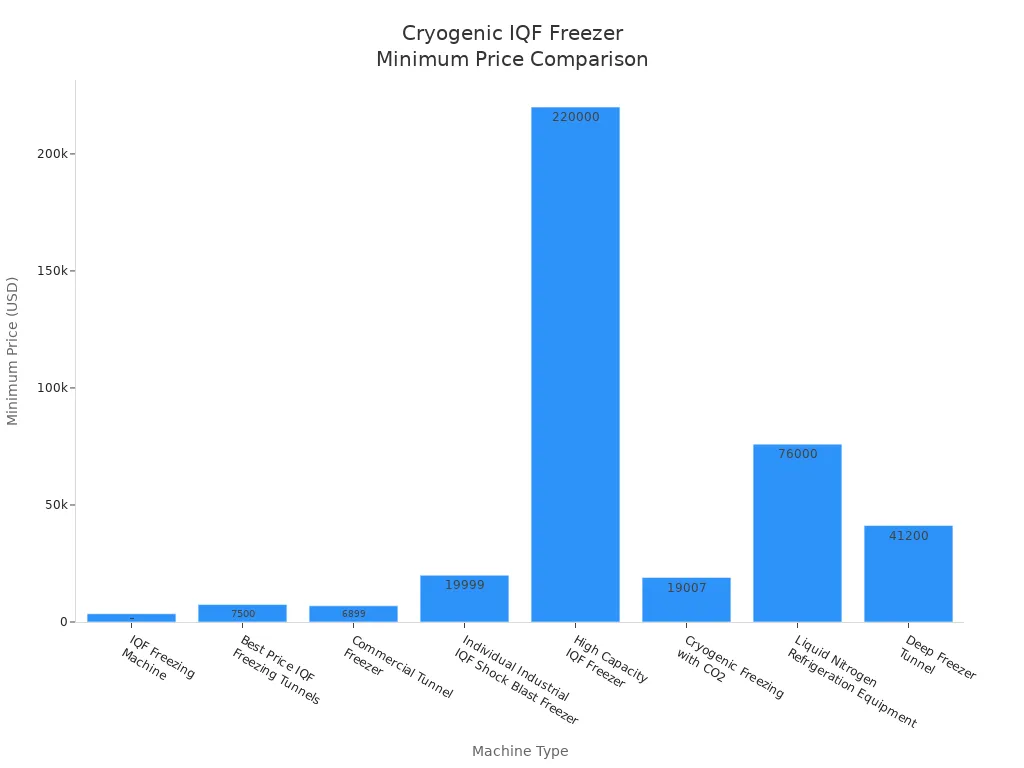
Cryogenic IQF freezing machines can cost a little or a lot. The price depends on the size and type of machine. Machines that use liquid nitrogen or carbon dioxide can cost from $3,510 to $220,000. Running these machines costs more because you always need to buy cold gases. Over time, this makes them more expensive than mechanical systems.
Machine Type | Price Range | Technology Used |
IQF Freezing Machine | $3,510 - $220,000 | Liquid Nitrogen / Carbon Dioxide |
Best Price IQF Freezing Tunnels | $7,500 - $8,000 | Liquid Nitrogen |
Commercial Tunnel Freezer | $6,899 - $12,999 | Liquid Nitrogen |
Individual Industrial IQF Shock Blast Freezer | $19,999 | Liquid Nitrogen |
High Capacity IQF Freezer | $220,000 | Liquid Nitrogen |
Cryogenic Freezing with CO2 | $19,007 | Carbon Dioxide |
Liquid Nitrogen Refrigeration Equipment | $76,000 - $80,000 | Liquid Nitrogen |
Deep Freezer Tunnel | $41,200 | Liquid Nitrogen |
Cryogenic freezing is great for IQF foods, especially when you want each piece to stay separate.
Mechanical systems cost more to set up but save money later.
Product Quality
Cryogenic IQF freezing keeps food looking and tasting good. It uses flash freezing, so food freezes almost right away. This keeps the inside of the food safe and helps it taste fresh after thawing. You get very good quality, especially for soft foods like berries, seafood, and ready meals. Cryogenic freezing helps stop food from getting mushy or broken. Always think about quality when picking between mechanical and cryogenic systems.
Mechanical vs Cryogenic Comparison
Key Differences
When picking an iqf freezing machine, you should know how mechanical and cryogenic systems are different. Each one uses its own way to freeze food. They are not the same in speed, quality, cost, or how they fit your business.
Here is a table that shows the main differences:
Feature | Mechanical IQF Freezers | Cryogenic IQF Freezers |
Freezing Speed | Longer freezing times due to higher operating temperatures | Rapid freezing times, maintaining product quality |
Product Quality | Potential loss of quality due to ice crystal formation | High product quality retention |
Cost | More capital intensive, hazardous refrigerants | Less capital intensive, but higher operating costs |
Mechanical freezing takes longer to freeze food. It uses warmer temperatures, so bigger ice crystals can form. This can make soft foods lose quality. Cryogenic freezing uses very cold gases like liquid nitrogen or carbon dioxide. These gases freeze food super fast. The food stays fresh and keeps its texture and taste.
Cryogenic systems are cheaper to set up. You do not need as much equipment. But you will spend more money on cold gases every day. Mechanical systems cost more at first, but you save money later because you do not need to buy gases all the time.
You should also think about how much food you want to freeze. Mechanical IQF freezers are good for freezing lots of food. Cryogenic IQF freezers work better for small batches or special foods. If you want to freeze many kinds of food, cryogenic systems give you more choices.
Here is another table to help you compare flexibility and scalability:
Aspect | Mechanical IQF | Cryogenic IQF |
Production Volume | Scalable for high-volume production | Ideal for rapid throughput and quality |
Flexibility | May have limitations in product types | More adaptable for boutique products |
Note: If you need to freeze a lot of food every day, mechanical systems are a strong pick. If you want to freeze small amounts or gentle foods, cryogenic systems might be better for you.
Pros and Cons Summary
This summary can help you choose which system is best for your business. Each one has good and bad points.
Mechanical IQF Freezing:
Can freeze large amounts of food.
Uses air to freeze, which saves energy.
Needs more money to start.
Uses ammonia or other dangerous refrigerants.
Can lower quality for soft foods because it freezes slower.
Works best for things like vegetables, meat, and seafood.
Cryogenic IQF Freezing:
Uses liquid nitrogen or carbon dioxide to freeze food fast.
Keeps food quality high, even for soft foods.
Costs less to install, but you pay more for gases over time.
Gives you more options for different foods and batch sizes.
Needs good packaging to stop freezer burn.
Works well for ready meals, berries, and special foods.
Tip: If you want your food to stay fresh and keep the best quality, cryogenic freezing with liquid nitrogen or carbon dioxide is a great choice. If you want to save money over time and freeze lots of food, mechanical freezing is better.
Always pick the system that matches your business goals. Think about how much food you freeze, what kinds of food you have, and your budget. Both systems can help you give your customers high-quality iqf products.
Choosing an IQF Freezing Machine
High-Volume Processing
If your business is big, you need a freezer that can handle lots of food every day. Mechanical iqf systems are good for freezing large amounts. These machines freeze food fast and help save money over time. You get the same results each time and can add more machines as you grow. Mechanical freezing works best for strong foods like vegetables, meat, and seafood. Sometimes you might see ice crystals, but most foods still look and taste good.
Cryogenic freezing is also good for expensive foods that must be top quality. This method uses very cold gases to freeze food super fast. It helps keep the texture and taste, especially for soft foods. But you will spend more money on gases like liquid nitrogen. If you want to freeze fancy foods or need things done quickly, cryogenic freezing is a smart pick.
Here is a table to help you compare the main things for high-volume processing:
Factor | Mechanical IQF | Cryogenic IQF |
Product Type and Quality | Best for strong foods with some ice crystals | Best for fancy foods with little texture change |
Production Volume and Throughput | Good for saving money when freezing lots of food | Great for fast freezing and expensive foods |
Operational Costs | Lower costs over time | Higher costs for better quality |
Safety and Compliance | Needs regular check-ups | Needs strict safety steps for cold temperatures |
Operational Flexibility | Can be changed to fit your needs | Works well with other supply chains |
Mechanical iqf freezers are fast and work well for big jobs. Cryogenic systems are quick and keep food nice for special foods. Both can freeze lots of food, but your choice depends on what you freeze and your budget.
Small Batches & Startups
If your business is small or just starting, you need to think before buying an iqf machine. Do not get a freezer that is too big or costs too much. First, check how much food you need to freeze. Make sure the freezer fits what you need now and later. If your freezer is too small, you might have problems as you grow.
You should also see if the freezer works for your food. Some foods freeze better with mechanical systems. Other foods need cryogenic freezing to stay good. Saving energy is important too. Pick a freezer that uses less power to save money and help the planet.
Here are some things to think about:
Freezing capacity: Make sure the freezer fits your needs.
Technology compatibility: Pick the right method for your food.
Energy efficiency: Choose a freezer that saves power.
Cryogenic iqf machines are often cheaper to buy. They are good for small batches and special foods. Mechanical systems cost more at first, but you save money if your business gets bigger.
Specialty Products
Some foods need extra care when you freeze them. Soft fruits, seafood, and ready meals can lose quality if you use the wrong freezer. IQF technology helps keep each piece separate and looking good. Freezing fast at very low temperatures makes small ice crystals. This keeps the food’s texture and nutrition.
Here is a table showing what you need for special foods:
Requirement | Description |
Product-Specific Considerations | Soft fruits, seafood, and ready meals do better with IQF. Tests help pick the best freezing way. |
Rapid Freezing | Uses very cold temperatures to freeze food fast and keep it good. |
Individual Piece Preservation | Each piece is frozen by itself so nothing sticks together. |
Retention of Nutritional Value | Fast freezing keeps vitamins and nutrients in the food. |
Cryogenic freezing machines are great for special foods. They keep the taste, texture, and look of fresh foods. Mechanical systems, like the Messer wave freezer, also freeze each piece without hurting it. You get good results and save money while keeping food quality high.
Other Considerations
When you pick an iqf freezer, think about more than just speed and food type. Maintenance is important. Choose a freezer with belts and motors that are easy to reach. This helps you fix things fast and keep the freezer working.
Space is important too. Some freezers are big and need lots of room. Make sure the freezer fits in your space. Always check the size before you buy.
Tip: Always check safety rules for your area. Cryogenic freezers need special safety steps because they are very cold. Mechanical freezers need regular checks to stay safe.
Here is a checklist to help you decide:
Is the freezer easy to fix?
Does it fit in your space?
Are you following all safety rules?
Can the freezer grow with your business?
Picking the right iqf freezer means thinking about your food, your needs, and your plans. Take your time to compare and choose the freezer that fits your business best.
Conclusion
Picking between mechanical IQF and cryogenic machines depends on what your business needs. You need to think about what you freeze, how much money you have, and what you want to do later. Here is a table that shows different costs:
Cost Factor | Description |
Cost of Refrigeration | Money you pay for the cooling system |
Monthly Lease Costs | Payments you make each month to use the freezer |
Operating and Maintenance Cost | Money you spend to fix and take care of the freezer |
Freezer Production Costs | Costs you have when you freeze your products |
Make sure the freezer can be used as your business grows.
Think about what kinds of food you will freeze.
Get ready for what your business might need later.
You can ask local refrigeration experts or talk to suppliers for advice. This helps you pick the best IQF freezer for your business.
FAQ
What is the main difference between mechanical and cryogenic IQF freezers?
Mechanical IQF freezers use cold air and special liquids to freeze food. Cryogenic IQF freezers use very cold gases like liquid nitrogen. Cryogenic systems freeze food much faster. Mechanical systems are better for freezing lots of food at once.
Which IQF freezer is better for delicate foods?
Cryogenic IQF freezers are best for delicate foods. They freeze food quickly and help keep its shape and texture. Soft fruits and seafood stay nice when you use this method.
How much space do I need for an IQF freezer?
Mechanical IQF freezers are bigger and need more room. They have extra parts that take up space. Cryogenic IQF freezers are smaller and fit in tight places. Always look at the size before you buy a machine.
Can I switch from mechanical to cryogenic freezing later?
You can change, but you will need new machines and training. Cryogenic systems use different tools and safety rules. Think ahead if you might want to switch in the future.
How do I keep operating costs low with IQF freezers?
Pick the freezer that fits your needs to save money. Mechanical systems cost less to run over time. Cryogenic systems cost more each day because you need to buy gases. Keeping your freezer in good shape also helps you spend less.